On the next big rift

Have you, thanks to Brexit, lost old friends? One upside: that rift will help you deal with the next big split – on accepting the need to become more frugal in our consumption.  And if so, how and when to change habits? But, given our addiction to treats, how can we sweeten the pill of curbing our desires? How much do we love our liberty to consume?  

After three months in Hamburg, in 1979, I was horrified by West German signs of ‘Warenfetischismus’ (‘commodity fetishism’): leather trousers; luxury cars, gleaming sound systems; the presumption that growth is good. 

German industrial and cultural (re)production illustrates the seductiveness of the effective ‘brand’. Almost a century and half ago, Germans built the first internal-combustion engines, followed by Daimler and Benz with the first luxury automobiles. Even the logo originated in Germany. Dürer’s endures – and survived the Nazis’ claim upon him [1].


Son of migrants from a Hungarian village Ajtós, meaning Türen (doors) and changed to Dürer, he used that in his monogram: ‘A’ for Albrecht being stylised doors, with ‘D’ in the portal. See Stefan Trinks, 28.09.19 faz.de

Although it’s common knowledge that Hitler envisioned a car for the people, the Volkswagen, less well-known is his plan to match American car production and mirror the success of Ford’s Model-T (of which, by 1923, 5 million had been sold). In fact, the British occupying force made the first VW ‘Beetle’; whereas the Americans drove forward mass West German car manufacturing[2]. After the Allied destruction of the Third Reich, with Marshall Aid[3], West German industry – drawing on its technical expertise in precision engineering[4]– engendered the Wirschaftswunder (‘economic miracle’)

Financial crises and diesel scandal notwithstanding, west German car manufacturing has kept on growing. Latterly, I’ve been kept agog (and awake) at the sight and sound of freight trains carrying BMWs and Mercedes to Bremerhaven – for export, to the People’s Republic of China. What would Marx say to that? No doubt about it: “Scheisskapitalismus[5].

And then there’s the domestic market. Last year alone, 1 million SUVs (designed originally for the Great Plains) were sold in Germany. Given the push for e-vehicles, and the resurgent Greens, it’s surprising that the ‘Grand Coalition’ hasn’t taxed SUVs, to fund alternatives to the gas-guzzling ‘Stadtpanzer’ (urban tank). https://www.spiegel.de/plus/klimakiller-suv-das-symbol-deutscher-doppelmoral-a-00000000-0002-0001-0000-000165926161

Now even in Russia, successor to the ‘state capitalist’ Soviet Union[6], the environmentalist voice is getting louder.  Scientists from Tomsk, studying the environmental consequences of permafrost thawing beneath the Artic Ocean, have happened upon methane bubbling up through the East Siberian Sea. Russians are right to be alarmed. See https://www.ecowatch.com/siberia-sea-boiling-methane-2640900862.html

I can well understand the frustration of eco-activists in the West at the enduring ineffectuality of ‘green’ political parties. As I’ve said – at my father’s suggestion forty years ago – I voted for the Ecology Party. Back in Yorkshire, I joined them. Within weeks, I found their campaigning cautious, their personnel uninspiring. German Greens, on the other hand, were vocal in signalling devastation ahead.

As I took this flyer from a couple of school-girls earlier this month, their angst was palpable.

Perhaps it’s my radical upbringing that compels me to try to locate Extinction Rebellion’s (XR) lack of formal structure on a political continuum, within a historical framework – the roots of ‘structurelessness’ running deep in anarcho-pacifist and feminist practice. In particular, there’s a continuity with other movements that engage in active non-violent civil disobedience (NVCD).  A thread runs through XR

flip-side of flyer

and peace movements: the fear of imminent wipe-out. My parents and family friends lived in such fear of nuclear extinction that they: founded Merseyside CND; engaged in Committee of 100’s NVCD; and in the case of a nuclear physicist in our Toxteth building, was taken into custody. (During the Cuban Missile Crisis, my parents were so afraid of imminent attack that we all slept in their bed – so we should perish together.)

CND demonstration, Holy Loch, Scotland, my parents are on the far left

Years later, my father told me of the discipline that was required in civil disobedience.

Stark as the future looks, with its nice words and the best will in the world, the mantra of NVCD has long been known to thwart objectives [7]

Moreover, using the purity of NVCD and the noble cause of freedom to protest leaves unanswered the question of accountability within an amorphous network. Indeed, the merits and demerits of NVCD were thrown into relief over last week’s protest on the London Underground. [8]

And there’s the impact, not only on workers en route to work, and on Underground staff, but on XR’s campaign: what will folk recall? The footage from a Tube station in a poor area of London, of commuters pulling XR activists from the roof of a Tube train, was shocking. But wasn’t this a predictable response, given the pressure of bodily mass in a tight space, of workers thwarted? 

What’s more, inciting rage runs the risk not only of physical injury, and backfiring strategy, but of inflaming reactionary forces. In addition to Alternative für Deutschland’s climate change deniers, other opponents of German eco-activism are rallying – insistent on maxing out their vehicular capacity [9].

As Margaret Atwood said last week, “There’s so much data and evidence. But people would rather adhere to a belief system that favours them.”
Lunch with the FT, 12.10.19

Shaping public opinion demands careful handling. As this model[10] shows, support and opposition can span a spectrum. (In a different context, the chair of my office LGBTQ network was keen to promote “straight allies”.)

Image:Joshua Russell Khan, cited by John Foran in Reimagining radical climate justice (see below link )

Of course, workers are consumers, as well as producers – and reproducers – using natural resources. Yet, no good can come of enraging the exploited. Instead of promoting environmental protection, German sociologist Nico Stehr suggests that alerting people to the dangers to them of climate catastrophe and environmental disaster is the only way to get them to take heed [11] .

Furthermore, democratic debate is needed to reduce the polarities over the next big rift. So, XR’s proposed Citizens’ Assemblies is an excellent starting point – perhaps to debate competing interests and conflicting rights; and measures necessary to protect individual citizens from climate damage. Finally, I would urge: harness technology, to re-program our consumerist compulsions – to cut out ‘must-haves’.


[ 1] A logotype was a symbol to divide or decorate a page, MacGregor, N. ch.19, Masters of metalMemories of a Nation, Allen Lane,2014

[2] MacGregor, N. ibid.

[3]The Bitter Taste of Victory, Feigel, L. Bloomsbury, 2016.

[4] MacGregor, N. ibid

[5] From Marx’s letter to Engels, exhibition commemorating 150thanniversary of publication of Das Kapital, Erster Band, in Hamburg, Museum der Arbeit, Hamburg, 2017
[6] From my father, I knew this of the USSR; with its “dictatorship over the proletariat”: Serge, V., Introduction, p.2, Year One of the Russian Revolution, Haymarket Books, 2015

[7]https://www.marxists.org/archive/sedgwick/1961/12/nonviolence.htm ‘Non-Violence – Dogma or Tactic? Socialist Review, December 1961, London

[8]https://www.theguardian.com/environment/2019/oct/17/extinction-rebellion-activists-london-underground

[9] Der Spiegel https://www.spiegel.de/plus/wer-hinter-fridays-for-hubraum-steckt-a-00000000-0002-0001-0000-000166262945

[10] http://www.iicat.org/wp-content/uploads/2017/01/John-Foran.-Reimagining-Radical-Climate-Justice-2016.pdf

[11] Der Spiegel https://www.spiegel.de/plus/klimawandel-wissenschaftler-plaediert-fuer-eine-aenderung-im-diskurs-a-00000000-0002-0001-0000-000166262946

On being silenced

When I left Hamburg in June 1982, having already had run-ins with fascist thugs in Bradford (see blogpost 3, What Goes Around), and having since seen a young woman from the Leeds punk scene captured with Hitlergruß on the cover of a pamphlet, [1] I was so terrified by a German neo-Nazi revival that I could not bear to return to Germany.

Last weekend I got back to Brixton from Hamburg. There, before a friend’s apartment block, I noticed eight freshly polished Stolpersteine (stumbling blocks) – commemorating by name, dates of deportation and murder, the Jews who had lived in those flats, whom the Nazis had rounded up. 

Stolpersteine, Isestrasse, Hamburg- a few doors along from number 98, where the Hesse family lived. In 1938, aged 3, Eva Hesse left apartment – on a Kindertransport. In 1965, Eva – now a ground-breaking sculptor – attempted to visit her old home – but the new occupants refused her entry.

The Third Reich is, for me, omnipresent in Germany. Those commemorating this centenary year of the Bauhaus, have posed the question:“What strategies did right-wing powers use back then?”  https://www.bauhaus100.com

My late father also deliberated this question, and the counter-strategies the German Opposition might have deployed to challenge Hitler. Whilst I was working in Hamburg in the early 1980’s, in his lecture series, Modern Political Doctrines, my father taught a course at Leeds University  – ‘Fascism and the Responses To It’ (originally entitled ‘Fascism and How To Fight It’, but that was deemed to sound insufficiently academic).

On my visits home my father and I discussed Fascism. Yet he never knew that, when we lived in Franco’s Spain, he had arranged for me to be schooled in the ways of Fascism. In January 1968, having asked a woman on a cobbled Frigiliana street the location of the school for girls, he unwittingly enrolled me in a seccion femenina. It was in a cramped loft that I was then subjected to Franquista indoctrination by a Falangist women’s section for young women and girls.

Similar building to that housing seccion feminine

Consuming a daily diet akin to Hitler’s prescription to women of “Kinder, Kirche, Küche”, I dutifully crossed myself in diminishing movements as twice-daily I ascended the loft stairs; transcribed the ‘Maestra’s’ dictations praising Franco and God; and copied simple sentences, to practice cursive hand-writing. Although I was intrigued that my elders did little other than embroidery, whilst gazing into the street below from the safety of the loft, I was frightened when a Guardia Civil arrived on our door-step – to interrogate my father. 

No text-books were available in the seccion femenina; however they were at my brother’s school

Back in England the following year, my father did his homework. He made sure I was aware of the struggle against Nazism and took me to see the newly released Battle of Britain, and Dunkirk (1958).

Plaque to airman killed in action during Battle of Britain, Sussex

My father was quick to emphasise that, without either American or Soviet military intervention, Britain would have lost WWII. (As a child, his beloved Balliol comrade, Raphael Samuel, had tracked the Red Army’s progress towards Occupied Europe.)

In addition to my father’s tribute to the inestimable losses suffered by both of those allies, I soon knew that the war had marked our family, as it had untold others’. The following gives a hint of the enduring resonance of the WWII narrative:

  • Great uncle: one of 8 survivors of the Spikengard, a Canadian Royal Navy vessel escorting an Atlantic convoy, sunk by U-Boot, 1942
  • Uncle Harry, Regimental Medical Officer: seriously wounded at Monte Cassino –  Liberation of Italy – airlifted to Southampton,1944
  • Auntie Olive (my father’s eldest sister) newly qualified nurse, who tended my uncle, as well as D-Day wounded, Southampton 1943-1945
  • Paternal grandfather: Merchant Navy steward, missing at sea from troop ship off coast of North Africa, 1944
  • Auntie Flossie and two sisters: called up to serve in Land Army and Timber Corps
  • My late mother-in-law, Irene: Fire Warden,  Bankside, Southwark, she supported US Army Signals Corps – bunkered 60 m. below Selfridges, Oxford Street, London.
Irene, last on right, coming up for air on Selfridges’ roof-top, weeks before D-Day

In contrast to some German contemporaries, the British can commemorate D-Day in liberating Europe[2], and display photographs of our foremothers and -fathers – and see them as heroines and heroes, whose war effort defeated the Axis. 

It was appalling, then, last week in Hamburg, to read of the targeting of a female Labour MP –  called out as “a fascist”, and of bricks through the windows of “traitors” in Lewes, Sussex.  In tandem with the oft-cited ‘Blitz Spirit’, this is the terrifying flip-side of invoking the dominant narrative of national pride in the Allies’ victory in WWII.

In this young century, fascistic fervour expressed through violence against women has seen the murder of two pro-European women politicians, each before a referendum on Europe. In Sweden, Anna Lindh was killed whilst campaigning for a “Ja” vote in their referendum on whether to adopt the Euro. 

When the news came through my colleague’s Twitter feed that Jo Cox M.P. had been shot and stabbed to death, I said it was likely a Neo-Nazi attack. Having lived in West Yorkshire, I knew only too well that readiness to use violence is a distinguishing feature of fascism. It was no surprise to me that nationalist ideology, manipulating unresolved conflicts in relation to identity, had morphed into murder. 

There can be no doubt that “right-wing powers’ strategies” continue to operate at an ideological level. [3] In serving particular group interests, it’s a commonplace that ideology can obscure material relations and present ‘common sense’[4] solutions to complex issues. 

Yet to impute thwarted ambitions and rage solely to those ’left behind’ by globalisation and austerity ignores the narratives of the ‘free-born Englishman’, as well as ‘our’ victory over Nazi Germany. Such notions are not political or economic, but of psychological and cultural character. That is the point at which Left and Right have converged, and not only in England and Wales.[5]

Moreover, to interpret election or referendum results by reference to the monoliths, ‘Us’ and ‘Them’, ‘Somewheres and Anywheres’, or the ‘disaffected’ and ‘the dispossessed’ is to reduce complexity to facile binary categorisations.[6]

Leaving aside tortuous interpretations of the ‘Leave’ vote, in the context of the above, it is reassuring to note that in response to the increase in support for Alternative für Deutschland in the former GDR, the German President asserted latterly that frustration doesn’t licence hostility. [7]

Finally, salient points in relation to the rule of law are made by Professor Dr Susanne Baer, Justice, German Constitutional Court. [8] In her 2018 lecture at University College London, Baer J. signalled alarming attempts to subvert judicial independence – citing Front National’s demeaning of French judges as “gouvernement des juges”.[9])

At the close of her talk, Justice Baer emphasised the vital need to maintain the rule of law, giving practical pointers for citizen action: attending rallies; organising conferences; blogs; song; and critical creative intervention and contestation – such as Marta Górnicka’s Constitution for a Chorus of Poles. (See: https://gorki.de/en/company/marta-gornicka)


[1] Women against Racism and Fascism, Centre for Contemporary Cultural Studies, University of Birmingham, 1979.

[2] During a sea crossing on the 75th anniversary of D-Day, after a French interpreter had marked the Normandy landings as beginning La Libération, her German colleague kept schtum.

[3] The Concept of Ideology, Larrain, J., Hutchinson, 1979    

[4] A notion my father considered to be inherently right-wing, and so to be contested.

[5] https://www.thenation.com/article/meet-europes-left-nationalists/

[6] The Road to Somewhere. The Populist Revolt and the Future of Politics, Goodhart, D. Hurst & Co. 2017; see also https://www.theguardian.com/books/2017/mar/22/the-road-to-somewhere-david-goodhart-populist-revolt-future-politics

[7] Der Spiegel “Unsere Verantwortung kennt keinen Schlusstrich”

[8] The Bundesverfassungsgericht (BvG) assesses whether cases raise unconstitutional points and interprets Germany’s Basic Law (Grundgesetz). When founded, the western Allies ensured that the Federal Republic of Germany’s constitution included proper Separation of Powers (Gewaltenteilung) and a mechanism to preserve an independent judiciary. Although the U.K. has an ‘unwritten constitution’ its Supreme Court fulfils a similar supervisory function to that of the BvG. Miller (No. 2) is a paradigm example of the independence of the British judiciary: https://www.supremecourt.uk/cases/uksc-2019-0192.html

[9]The Rule of—and not by any—Law. On Constitutionalism Baer, S. Current Legal Problems, Volume 71, Issue 1, 2018. https://academic.oup.com/clp/article-abstract/71/1/335/5272691/

On the Perils of Looking West

As the U.K. was forced to shift focus westwards, away from Europe, I returned this summer to America. On venturing across ‘the Pond’, my excitement at seeing New York City was as undiminished as when I was 10.

In 1970, at my first Queens elementary school, I was impressed by a poster displaying myriad faces and proclaiming ‘Black is Beautiful, Brown is Beautiful, Red is Beautiful, Yellow is Beautiful’. This was outside the school canteen, where, together with children on Welfare, I queued for a hot mid-day meal. (Meat-balls being the usual offering, I longed for the tastier school dinners at my Oxford primary school.)

“…Give me your poor, your tired, your huddled masses, yearning to breathe free…” The New Colossus, Emma Lazarus

In the New Year of 1971, we moved to another part of Queens, and another grade school. In addition to taking her class to the Van Gogh exhibition at the Brooklyn Museum, my new teacher raised her pupils’ awareness of the impact of pollution, on the one hand, and looming budget cuts on the other – and exhorted us to write to local elected representatives. A child of radical parentage, it felt good to be encouraged to express opinions, and to be taken seriously in class (at the same school, in attending a meeting on feminism, Edie had been finding her voice).

By the time I returned to New York in 1998, I knew from UNISON colleagues that, under General Secretary Rodney Bickerstaffe, they had lobbied the new Labour government-in-waiting hard to bring in minimum wage law, like that in the U.S. But unlike there, we wouldn’t see targeted publicity.

Poster on Coke machine, French’s Diner, Marlinton West Virginia (1997)

Arriving in New York this year, I was struck by the extreme roll-back of the state.With subway infrastructure crumbling, and homeless folk sleeping next to me on trains, any semblance of a welfare safety net had gone. Basic incomes are so paltry that guidance to tip a quarter of a bill confirmed there’s no living minimum wage, with enforcement seemingly ineffectual. Never before had I come across such ingratiating deference as that I encountered in the U.S.: slight bows evoking the English servant class, the humble silence of the American precariat – and the racial hierarchies around which the U.S. is built.

To traverse America by train is to witness just how far behind its public transportation lags behind Western Europe’s – where, in addition to good metropolitan connections, high-speed routes whizz passengers through ‘the Continent’.

Union Station, Chicago

All the more shocking for a visiting Brit – already appalled by increased homelessness back home, including tents on streets and parkland – was the American acceptance that life on the margins is normal. Etched on my memory of Sacramento is a large woman in a crimson sun-dress, walking away from her family’s tent, baby buggies at the side, perhaps on her way to work from her home – one of numerous encampments by railway sidings.

Tent in park

On my first visit in 20 years, I felt the West had become a libertarian’s dreamland. When a fellow Amtrak traveller attributed homelessness on the West Coast to drug abuse – and so each person’s individualised problem – I countered that was not the whole story, but didn’t have to hand relevant data. On reviewing the evidence she had amassed*, Barbara Ehrenreich noted the ubiquitous fear of losing the roof over one’s head. Moreover, since 2000, certain states had criminalised the destitute – making it unlawful to give help or hand out food to the homeless on public space.

In other curious contemporary signs of ‘Manifest Destiny’**, Big Tech has colonised tracts of land on the West Coast; their workers’ settlement of neighbourhoods pushing up rents, and ousting poor local folk into insecure accommodation. And in tandem, insatiable demand for land presses others out of their homeland: fearful of imminent instability, super-rich businessmen are now founding private fiefdoms of swathes of states.

Not only other humans are pushed aside. Journeying west, it was odd to spot four solitary deer, each 500 miles apart – and to ponder the whereabouts of the rest of their herd.
As e-mobility takes off, to avoid a free-for-all, Boulder municipality imposed an emergency moratorium on the issue of business licences to e-scooter rental companies. Meanwhile, home-made e-skateboards, custom-built e-unicycles, or brand new e-skates, as well as franchised e-scooters threaten the safety of those exiled to the streets of San Francisco.See: Der Spiegel https://www.spiegel.de/plus/e-scooter-e-skateboard-e-einrad-so-kreuzt-man-jetzt-in-san-francisco-a-00000000-0002-0001-0000-000162162968

Two libertarian surprises awaited us on the Oregon coast. In Astoria (population 10,000) three stores sold marijuana and related products. With scant regard for the conditions in which workers harvest ‘weed’, cannabis is big business.

Cabinet of curiosities

A few blocks away, on display in a run-down Astoria store-front I spied two abhorrent objects: traps for sale – for one or two small animals respectively. Is it any wonder, then, that the Coastal Martin – lawful to hunt in Oregon – is critically endangered?

Further down the coast, the joy at sighting a Gray Whale foraging feet away on the shoreline jostled with data obtained by Monterey monitors that migrating whales were emaciated. The researchers said this was likely due to a decline in food, in turn attributable to a warming Pacific Ocean. Of course it is not only mammals, for which one feels distress: away from nature reserves, the West was bereft of bird-song.

And yet – it’s imperative, to dispel despair, to be awe-struck by the natural world.

Yaquina Nature Reserve, Oregon

Andrea Wolf begs us to be enthralled by Humboldt’s enchantment with nature***. Only by holding on to a sense of wonder, and pushing back against the making marginal of all things living in the world, can we envision an alternative to all-consuming capitalism.

Garbage barge, East River, New York City

*Nickel and Dimed: On (Not) Getting By in America, first published, 2001, republished Picador,2011

** “The right of our manifest destiny to overspread and to possess the whole of the continent which Providence has given us for the development of the great experiment of liberty and federated self-government entrusted to us…” John L. O’Sullivan, 1845

*** The Invention of Nature: Alexander von Humboldt’s New World, Wulf. A; The Adventures of Alexander Humboldt, Knopf, 2015 Andrew Wulf, illustrated by Lillian Melcher, Penguin Random House, 2019

A Land of Extremes

As 1975 began, I spied a book on my father’s shelves in his Leeds University office, 1975: The Year of Doom.By now the Oil Crisis had severely constrained resources in Britain; I had realised just how reliant we were on supplies from overseas. 

When school broke for the Easter holidays that year, I had mixed feelings about my trip to Münster, under the York schools exchange scheme. My father had told me about the Federal Government’s response to German radicals’ activism of the late Sixties and early Seventies: Berufsverbot, barring Left-wing public servants (the German Communist Party was banned). And I was aware of the Red Army Faction’s campaigns, which included bomb attacks. As York students had been intensely active, I was curious to see a German university town. 

To fetch up with a bourgeois, observant Christian family, with paterfamilias lawyer, a collector of objects d’art, was unsettling in the extreme.His daughter, Eva G. was 18 months younger; we had nothing in common. Münster struck me as austere and ultra-conservative. (To add insult to the injury of her denial of concentration camps in Germany on her visit to York, Eva G. stole a Hogarth print, which Edie had found in a second-hand shop; we were powerless to recover it.)

In late 1976, my father took me to see Kuhle Wampe (Who Owns the World?) a film set in Berlin during the Weimar Republic, conceived by Brecht, with Eisler’s music. Their Solidarity Song etched itself onto my memory: “Vorwärts und nicht vergessen, worin unsere Stärke besteht!” (Forward, and don’t forget, What our strength is made of!) 

Still from film, on BFI website

After the screening, I asked my father how against that backdrop, the Nazis had come to power. His clear answer: the failure of the Left to unite against fascism. For its useful insights, he also cited Reich’s Mass Psychology of Fascism (however orgone therapy, the efficacy of which Reich believed, was to be taken with a pinch of salt; having read about that I was pleased to hear this ).

On my return to Germany in 1979, as a citizen of a Member State of the European Economic Community, I exercised my rights of entry, settlement and movement, and soon found a highly paid job at a medicaments factory in Hamburg.

First I sat by a conveyor belt. Watching over it, I found myself so utterly alienated so as not to switch off at night:  thousands of little green bottles swam before my eyes. Packing at least allowed for conversation. One morning, stuffing strips of the Pill into individual boxes, talk turned to Hitler. An older colleague said: “Wir waren alle Nazisten.” She elaborated: they had all attended parades off Nazi might. Given the sinister Münster family, I was disturbed yet not surprised to hear this. To add to my disquiet, on Friday evenings, as we stood by the gate awaiting the horn’s release for the weekend, a German colleague, in furs and jewels, looked down her nose at those from Yugoslavia or Turkey. 

This was my residence permit:

Seeking out connections with my homeland, and with nature, in my free time I took to walking by the Elbe, along which I had sailed from Harwich.

Often of an evening I strolled to the port, captivated by its ships and flashing signals. Aware that Hamburg had been heavily bombed during WWII, I was amazed to witness industrious shifting of container cargo. The contrast with Liverpool troubled me. The previous year, I had wandered along the Mersey, saddened that passenger ferries to the Wirral or Ireland were the only vessels on that river, and by the wreck that was the Albert Dock.

Like Liverpool, Hamburg stood out for its distinctive language and culture, and Hamburgers were lively and friendly. Also, alternative living in communes and gay café society had taken root. Seeking out such friendly spaces sustained me through the working week, and helped me process news from home. 

At the end of April 1979 my father had phoned me to tell me that he could not bring himself to vote Labour in the imminent General Election. As I was to be a first-time voter, he suggested that one of us voted Labour and the other Ecology Party. As my job immersed me in chemicals, and being aware of manufacturing’s destructive effluents, I readily agreed. On May 4, he rang again: the Conservative Party had won. We agreed: this was a turning point. [1]

After my factory stint finished, German friends took me to West Berlin. We speeded past Hamburg’s affluence, along the autobahn. As soon as we cleared border control and crossed into East Germany our pace slowed: the road had only two lanes. Although placards spanned fields proclaiming thirty years of the German Democratic Republic, I was swept back ten years – to my spell in Andalucía. There, I had noted men bent over strips of terraced earth. In the GDR, I saw older women, their Fifties frocks illumined by the setting sun, guiding horses and ploughs through communal furrows – evoking the backward agrarianism of Franco’s Spain.

Berlin, away from the expensive cafés and shops near the touristic Kurfürstendamm, felt less like an advanced capitalist city than did Hamburg. Wandering past Kreuzberg’s courtyards, I was transported back to Kuhle Wampe. Most Westerners paid a visit to the Wall, to peer into East Berlin, but having driven through the GDR, I could not bear to do so. At a late-night party in a squatted gay centre or searching for lesbian bars, I sensed the Wall’s divisive presence.

It felt liberating to wander without fear. And what a thrill it was to find, in a dark Schöneberg side street, the Pussycat Bar: mauve velvet bankettes lined the walls and the glow of dangling crystal sconces made an intimate women-only space. Pondering life on the other side of the Wall, as I drank a beer, I wondered what options East German lesbians had.[2]


[1]Once electoral data had been analysed, my father told me that a third of trades unionists had voted Conservative.

[2]In a sign of the times, the Pussycat Bar is no longer women-only; see:https://berlin.gaycities.com/bars/305575-pussycat

What Goes Around…

Finding myself displaced by organised politics in the mid-1970’s, I happened upon two sources of sustenance. The first was new political theatre, at York Arts Centre. There, my father and I were riveted by electrifying Agitprop productions of workers’ theatre, including 7:84* and women’s theatre, such as Monstrous Regiment**

Photograph: Jill Posener

The other comfort was music, especially during the alarmingly hot summer of 1976.  Squirreling away funds for gigs and festivals, babysitting topped up my wages from my regular job at a pottery (a repetitive routine of scraping mugs and emptying kilns). Another music lover proposed youth hostelling, between camping at Knebworth and the Reading Festival. 

At the latter, I was horrified to hear racist abuse directed at the reggae artist, U-Roy. As an antidote, and with time to spare before our night-coach to York, my friend and I went to the Notting Hill Carnival. As one of my erstwhile babysitters lived in the area (on a previous visit she had suggested I form a feminist discussion group at school) I knew Joy would welcome us to Carnival. After leaving our bags at Joy’s flat, we joined the throng of carnival-goers, but most striking was the substantial police presence lining both sides of the streets. Tensions were palpable, and as conflict surfaced we left.

In May 1977, I attended my first Punk gig, The Clash, at Leeds Polytechnic.  The backdrop to the stage was a hugely enlarged press photo of the Notting Hill riot. That image resounded on two levels. First, I was there. Secondly, having latterly read commentary on Brecht (for German A-level) the black-and-white backdrop was like a placard.  To remove any suggestion of naturalistic performance other Punk bands deployed harsh lighting, frenetic beats, tuneless vocals, jerky movement and angry pose.  The disruptive energy of Agitprop had, in my view, partly sparked Punk’s conductivity of discontent. https://madmuseum.org/exhibition/too-fast-live-too-young-diehttps://madmuseum.org/exhibition/too-fast-live-too-young-die

We disaffected young people, facing unemployment or limited prospects (as my new friends were) jumped into the newly turbulent music scene. Not only did Punk break with Rock’s tradition, but its volcanic fracturing of staid surfaces released free-spiritedness. Having been to funky feminist band*** Jam Today’s York benefit concert earlier that May, these new musical forces signalled, to me, freedom from the strictures of gender and sexuality identity. 

In the North, second-hand clothes for punk outfits could be had for a few pence at jumble sales. Shocking pink dye served the dual purpose of converting a jacket and subverting prescribed feminine attire. My androgynous ‘look’ was at odds with the hyper-sexualised fish-net stockings and almost non-existent skirts a few young women sported at gigs. The sight of them troubled me: why revert to stereotypes to shock folk; and how could they dance in stilettos? 

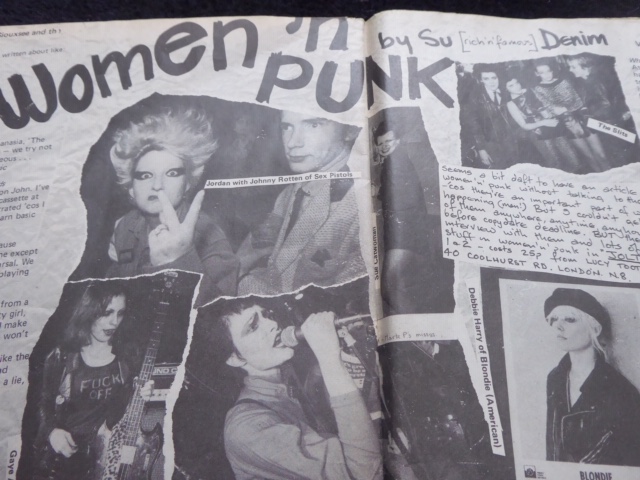
Those of us who were receptive to feminist influence were fortunate to find a sympathetic ear at York Women’s Centre and the Corner Bookshop in Leeds, where my friend, Shirl and I each bought a special fifth birthday edition of Spare Rib, with this article on Women and Punk

See: https://www.bl.uk/spare-rib

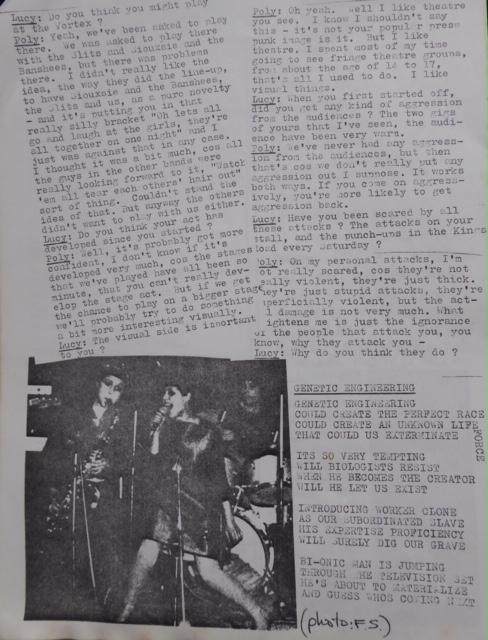
From that we tracked down Jolt. Here’s an extract of Lucy Toothpaste’s interview with the frontwoman of X-Ray Spex, Poly Styrene (sadly no longer with us).

Punk, in combination with feminism, enabled us to push at boundaries. Shirl and I jumped at the chance to carry The Slits’ heavy kit, in return for free entry to their gig (that afternoon we had hitched to Leeds from York, and wanted to save even more money). The organiser’s jaw dropped: he said he’d expected lads not lasses. 

Another deeply unsettling spin-off from Punk was the freedom of expression it gave to the confused or alienated. One friend refused to be known by her name, having opted for a Bowie persona. Adamant that she didn’t want to be in a woman’s body, ‘Zed’ none the less chose relationships with women. My feminism sounded an alarm. I wondered whether Zed, keen to transition to a male identity, was in fact a young working-class woman who, given the constraints upon her, couldn’t accept her sexuality identity – as a lesbian. ****Despite the androgyny of Punk bands and New Wave musicians such as Patti Smith – whose album Horses we young dykes revered – it would take a much bigger lift-raft to rescue those who were adrift, like Zed. 

Attracted by its disruptive effects, a minority of punks gave vent to racist vitriol. Hatred of difference manifested in other thugs’ pursuit. Once, with hearts pounding in our mouths, while they searched us out, my friends and I hid in a railway carriage. 

Such terror was normal. To counter it and the racism that had long been accepted on the music scene, bands and fans were mobilised to oppose racism at gigs. In West Yorkshire, where the NF had a strong following, Rock Against Racism groups organised. The Tom Robinson Band performed at Bradford. In Leeds The Mekons – with Mary Mekon on bass – and the feminist three-woman Delta-5 impressed me with their courageous discordance. 

RAR’s message was effective: at gigs, stalls displayed anti-fascist and anti-racist banners, emblematic badges, and the fanzine, Temporary Hoarding (for which David W. and Lucy Toothpaste wrote).At the end of April 1978, I caught the Anti-Nazi League coach to London.  Thousands marched, fetching up at a free festival in Victoria Park, East London. A friend whisked me away from the park, however: rather than listen to music, we should make our presence felt in Spitalfields, where the NF was assembling. 

Photograph by Paul Trevor in Brick Lane 1978, Stepney Books Publications,1994

In September 1978, I headed from Leeds (where I now lived and worked) to London for a second ANL rally. Marching with many others, the diverse vibrancy and collective show of strength instilled hope. Then, as we proceeded along Railton Road and neared Brockwell Park, I was enchanted by the Brixton Fairies, glittering in sunshine, waving us on from their gay squats.  Yet, on returning to Leeds I had to watch out for NF thugs, and the Yorkshire Ripper.

In January 1979, my father and I attended a meeting on Feminism and the Left at a Bradford bookshop. Being the first to leave, he opened the door – to be greeted by men leaping through the air, their rallying cry: “Let’s get the Commie bastards!”.  We slammed the door shut in their faces. 

Soon afterwards, the Winter of Discontent at the back of me, I set sail for Hamburg – for better pay than I got at a Leeds hospital.

* 7% of the British populace owned 84% of its wealth.
** http://monstrousregiment.co.uk 
*** https://womensliberationmusicarchive.co.uk/j/ **** After my father’s suicide, in 1983, I saw Zed in Wakefield. Having shaken off the old identity, she said that after referral for treatment and prescribed medication, she had realised, just in time to avoid invasive surgery, she had herself been in a deep crisis.


Groundhog Day (Der Tag des Murmeltiers)

As 1969 began, I wondered what the year would bring. Having checked out our neighbourhood, it was clear that our house straddled the class divide. On the opposite side of our street, mothers drove their smartly uniformed children to private primary schools. Our backyard gave on to a terrace of small houses, in which working class folk lived. The children opposite said the children at the back were the ‘Gasworks Gang’, and being ‘rough’, were to be avoided. 

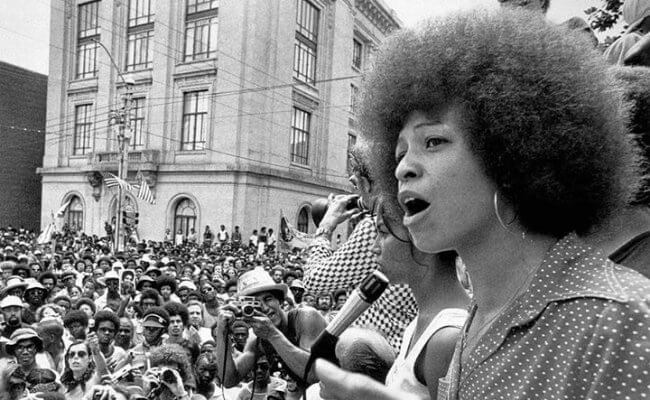
One summer evening, as I was standing outside our house, the privileged kids lured me along a lane and, grabbing my limbs, shoved me into a row of nettle bushes. Avoiding the front that summer, however, I retreated into our backyard, where I reflected on my heroines, Angela Davis

Angela Davis: Portrait of a Revolutionary, dir. Yolande DuLuart, 1972

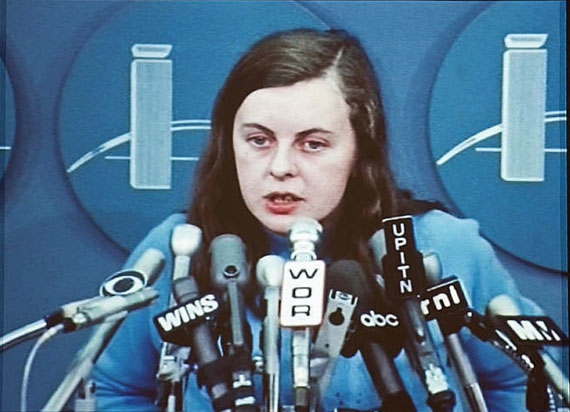
and Bernadette Devlin. When one day my younger next-door neighbour told me her Northern Irish mother called Bernadette “a devil” I was shocked: this was the first time I had encountered white-on-white prejudice.

Still from Bernadette, Duncan Campbell, 2008

I was a relief, then, to spend two weeks at a friend’s flat in North London. Highlights were regular and adventure playgrounds (with high slide that as soon as I slid put paid to the labour-saving paper knickers I wore that holiday); and bright yellow lemon ice-cream from an Italian café in the market. It felt good to see the smiling friendly faces of David and his partner, arm-in-arm, as we all strolled under a sun-lit avenue of plane trees in the local park. Darkness fell, however, when one evening (with my parents) I watched a programme about the Nazis’ camps. From that night on, sketches of the gas chambers and images of gas sprinklers pressed in on me.

At the start of the school year my teacher asked about our summer holidays. My class-mate, Denise (who also wore NHS glasses and so counted as a kindred spirit) said she had been to visit family in Ulster. Mrs Clark mentioned the deployment of troops and asked Denise if the trouble in Derry had been scary – it had.

Unsettling on another level was Edie’s departure that term for Hillcroft College, near London, where she took a second chance at education – in a women-only setting. From there she slipped into the first national women’s conference, at Ruskin College in 1970. Meanwhile, kind women members of the IS baby-sat while my father attended meetings. My confidence had returned: when I ventured out front I was struck by Conservative Party General Election posters – sported by the children opposite atop their tricycles. 

A month or so later that 1970 summer of 1970 after Edie’s return to York, in summer 1970, she told me that we would soon move to New York, for a year. I wondered what arrangements would be made for the 11+ exam on my return.  Although New York City was exciting – Edie took me to Judo, as “every girl should know how to defend herself”, and my father taught us ‘Wobblies’* songs – I fretted about the exam. In September 1971, my father and I returned to York (Edie saw Liverpool family) so that I could sit the Eleven Plus. While I worried that the school year had begun by then, he coached me for the exam. 

That October I was admitted to a girls’ grammar school. The contrast with American beliefs in freedom and equality was so stark that my cultural dislocation was complete. I felt injustice – on behalf of other children, including Denise, who had failed the exam and gone to the secondary modern. That autumn I happened upon a small book on our mantelpiece:

At my school the banned book was a sensation: at dinner-time it was passed along the queue, or pored over behind raised desks, by girls in navy uniform.

Finding my voice, when our class teacher asked what we would like to discuss – and aware that Edie had been to a feminist meeting at my Queens elementary school, where she had befriended Lola, a Black American from the Deep South – I suggested Feminism. I was crestfallen when my classmates expressed no interest in it.

The new year saw further emotional disruption: Edie threw my father out of the house. I attempted to connect with him, through politics, during a febrile time. Although it was made clear that I could not take part in the protest against Bloody Sunday, soon afterwards, in February 1972, I was permitted to attend a rally of striking miners. Inside the Knottingley miners’ club, amidst massed masculine expression of resistance to the Heath government, I was bemused to find that, fluorescently illumined bar staff aside, I was the only female. 

Perhaps sensing my dislocation, my father suggested I attend a meeting of Rebel, the IS youth group. As soon as I arrived I felt it was not the place for me: either bearded or clean-shaven youths, the latter disillusioned Army recruits, took the floor. My father took me to a talk on Free Schools, as well as days away from school to Oxford, London and Edinburgh – where he was to speak about the Left, and R.D. Laing, whose arch-critic he had become. 

The following year I began to harangue my father about the male dominance of the IS. By the end of 1973, however, I had decided to give them a second chance. So I agreed to go to the IS conference at the Belle Vue Stadium in Manchester. There was much excited discussion of capitalism in crisis. After alighting the coach, I told my father that I had overheard the young daughter of the esteemed worker in the seat behind tell of his battering of her Mum. Edie had by now cited Simone De Beauvoir’s The Second Sex. ” One is not born a woman” resonated throughout my teenage years.

The beginning of 1974 saw the conjunction of the Oil Crisis and miners’ industrial action, which resulted in the so-called Three-Day Week, whereby electricity was in short supply. Not only were heat and light rationed – so schools and offices closed two days per week – but public transport and private car usage were curtailed and long queues formed at petrol stations. Eventually these restrictions were lifted, but the damage to the Heath government was done: Labour came to power later that year.

Early one summer evening in 1975 my father voted in the EEC** referendum. When asked why he had voted to leave, he told me that the EEC was a capitalist market, where international workers’ solidarity was ruled out.

* The Industrial Workers of the World (IWW), international labour union founded in the early years of the 20th Century. 

** European Economic Community, now European Union.

1968:One Girl’s View

In this, my first step into the blogosphere, I sketch a Sixties’ childhood, to the end of 1968. 

This photograph shows my late parents at a CND march in Liverpool in 1959. Edie, my mother, was pregnant with me at the time.

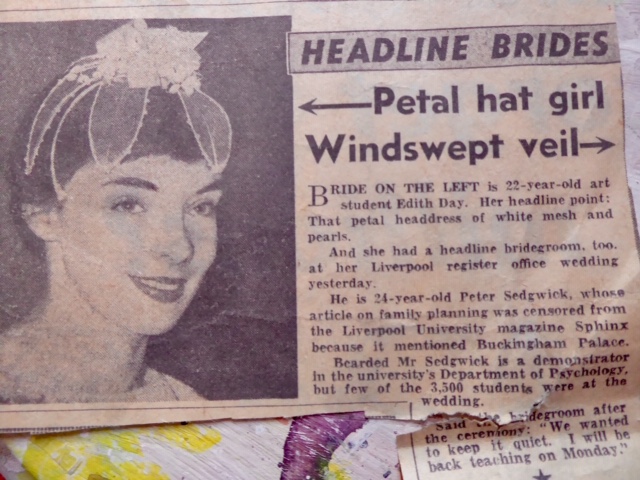
Shortly after this march, Liverpool University sacked my father – after he had published an article demanding an end to the London Rubber Company’s monopoly of Durex. [The Sunday Express]

In 1963, after my father had finished translating Memoirs of a Revolutionary, we left Liverpool 8 (Toxteth). After over a year’s constraint in the brand-new Grendon prison estate, we moved to an ex-council house in Oxford. 

Our new home, a 1930’s semi without bathroom or indoor toilet, gave my father the spring-board from which to launch into an arc of political agitation. This was to span analysis, including his critique of Marcuse, and attendance at numerous meetings. At one such C. Hitchens recounted his first encounter: “He was a short,slightly misshapen fellow …After some general chat he rather diffidently handed me some of the “literature”…of a group called the International Socialists”.*

For my father, political engagement was all-consuming. Fortunately for him, his week-day work (on head injuries) was undemanding, affording time to devote to activism. When time did permit, he told me bed-time stories. Of special note was the infiltration by Stalin’s agent of the Trotsky household and of his murder, by ice-pick hacked into his skull. As a settling-down story this did not feel odd: from the weight of my father’s work on Serge, and with the IS, I was aware of Trotsky’s significance for revolutionary socialists. I drifted to sleep to the clacking of my father tapping on his typewriter.

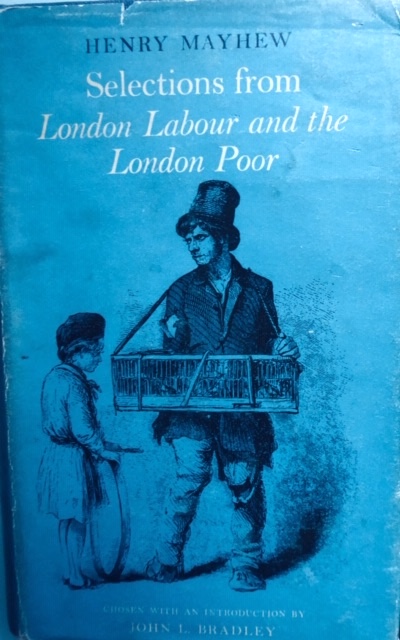
In view of her house-work, my mother was unable to pursue her own political struggles. Perhaps sensing her domestic labour was burdensome, Raphael Samuel, Ruskin Tutor, brought her treats. As well as parcels of Brie and Brunost, he brought her this pocket-sized Mayhew. Intrigued by such gifts and enchanted by him, I relished Raphael’s visits.  

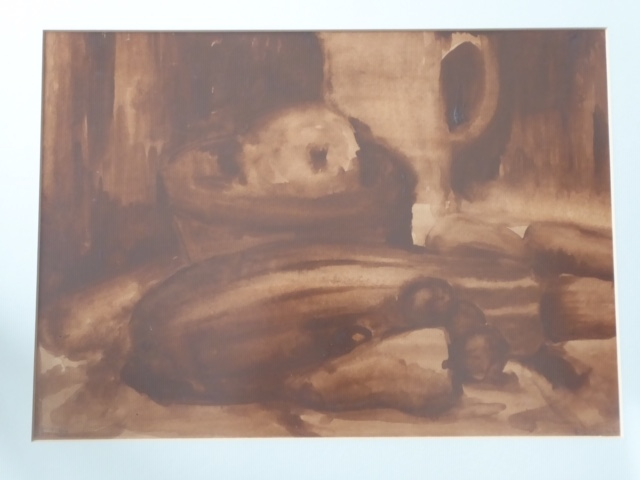
To express her creativity – her parents having forced her to abandon her art school scholarship for a factory job –Edie found an outlet, and so was able to extend her own network: enrolled as a day-student at the Oxford School of Art, she painted. Although she made abstract work, I preferred her representational paintings such as that depicting two Indian women seated side-by-side, and this, my favourite, a still life. 

Edie’s art tutor was Diana Veale, who also visited: an older woman with silver chignon, immaculate make-up and gleaming ebony cigarette-holder. Her frostiness contrasted with the unfailingly open, warm generosity of spirit of our young visitors; but her calm composure awoke awe in me. Viewing Edie’s work on the walls, Diana showed neither interest in us children, nor our father. Against the backdrop of his work, Diana’s focus on our mother and her art confused me.

By Summer 1967 Edie was exploring photography. In one photograph she foregrounded me at a rally against Wilson government policy which we attended together. 

At the end of the year, we set sail for Spain where, in an Andalusian village, my father could focus on his second Serge translation. He found me a “Spanish school”. It would be another thirty years before I would learn that in fact it was a Falangist seccion femenina. The following Spring, having returned to England, the teacher at my new school asked what subject my father taught. I pleaded ignorance. Aware that Politics was a dangerous subject, I chose to come across as stupid. In the face of further questioning, I stuck to that stance.

In early April, the murder of Martin Luther King was incomprehensible. Not long afterwards, Bobby Kennedy was assassinated. Despite living in the closed community of the York university campus, my father’s activism and Edie’s engagement brought home outrage at the atrocities that were being committed world-wide, as well as campaigns in response.

That summer various people stayed with us, and some discussed revolutionary politics. Two young people who visited from London were of particular interest. Sheila ‘Robot’ (as I understood her last name) seemed studious and observant. David, a medical student, impressed me with his skill in fixing an Action Man, which, irritated by the perfection of that war-toy, and aware of Biafra and Vietnam, I had tried to make more true-to-life, and in the process of bashing it to the floor, detached its foot.

Although I detested the concrete campus, which evoked Grendon, it was an exciting place for children. With seemingly unbounded freedom, we played on great expanses of green and made dens in long grass. Finding quiet times to sit alone in our courtyard, I was captivated by Edie’s gift of a collection of stories, in which the lives of African children were unfurled.

One August afternoon, a grey tent of a sky hanging over the campus, my father and I happened upon a colleague of his and I was horrified to overhear that the Soviet Union had crushed the Prague Spring. 

[Der Spiegel http://www.spiegel.de/plus/prager-fruehling-1968-sie-schossen-sofort-a-00000000-0002-0001-0000-000158843496]

I can no longer recall when or where I was, when on the News I saw massed protestors in London, but I remember Edie saying: “Your father’s on that demonstration” and searching for him amidst the throng protesting against the Vietnam War.

[Evening Standard Getty Images]

By then we were living in a ramshackle house in York. My last memory of 1968 is of Cliff, the IS patriarch’s visit: he, David and my father, their rapt faces illumined by a bare light-bulb, engaged in urgent debate. Standing close to them, I noticed Edie where she was standing against the wall, demure in shadow. Excluded by male discourse, and shaken by Cliff’s abrasiveness, I was left in disquiet, as the year drew to its close.

*Hitch-22; the International Socialists (IS) was the predecessor to the SWP.

Design a site like this with WordPress.com
Get started