A Radical History Tour

Last weekend, I led a party of socialists on a walk along Brixton streets.

Bon Marche,‘ The Bon’, Britain’s first department store,opened in 1877
Before joining up, Violette Szabo worked at ‘the Bon’, selling perfume.
Plaque Lambeth Town Hall
From Valour and Victory
commemorative stamps, issued May 2025
In addition to pioneering the scientific study of sexuality, Havelock Ellis was a founder of the Fabian Society
Founded 10 years ago as a community hub, built from 55 shipping containers
Photos on display at Brixton Rec have included back-lit Cyanotypes of women swimming
Replacing the irreplaceable: Brixton House, successor to Oval House Theatre – in the 1980s a crucible of radical, gay, and feminist theatre
Southwyck House (‘the Barrier Block’) designed by Polish refugee Magda Borowiecka
121 Railton Road, squatted in the 1970s – a centre of resistance
Mural on wall of 198, a contemporary art gallery on Railton Road
Author of The Black Jacobins, C.L.R. James engaged with the rage on the streets of Brixton during the 1981 Uprising
Former office of Race Today, now home to the Brixton Advice Centre
Thomson worked on Street Life in London at his home on Effra Road. A brief essay by the activist Adolphe Smith accompanied each of the 12 photographic instalments *
Black Cultural Archives Windrush Square
Sculpture of Claudia Jones, founder of the first Caribbean carnival, held in 1959 at St Pancras Town Hall – with the slogan
“A people’s art is the genesis of their freedom”
Brixton Orchard, founded 2017, grows above a former ‘RSG’ bunker – a Regional Seat of Government
  • Street Life in London and the organisation of labour, Angela Vanhaelen, History of Photography, Vol. 26, no. 3 Autumn 2002

Beyond Borders

As indicated previously, I was raised by socialist peace activists; my parents having been ‘war babies’ who were evacuated to escape the ‘Liverpool Blitz’. (A favourite bed-time story of my father’s was to tell me how,as a child, he had helped his father put out a German incendiary bomb that had fallen on their house, which they had to vacate due to bomb damage.)

Growing up amongst the International Socialists during the 1960s and 1970s, I heard about American and Soviet imperial over-reach. Recent events have, inevitably, evoked conversations with my father of a half century ago.

When I asked him about the rise of the Nazis, my father was clear: the failure of the Left to unite against Hitler resulted in Nazi success at the polls in 1933. As to the anti-democratic forces currently deployed on social media- and the use of freedom of expression as a ‘sword’ rather than a ‘shield’ – my father’s clarity would be welcome. On asking him why, given one’s notions of ‘English fair play’ and freedom of speech he said that neo-Nazis should not be given air-time, he replied that the only way to deal with them was by way of pest control – drawing a parallel between fascists and rats.

Propaganda Art, London, 1938

Having seen a recent exhibition of the work of the Film and Photo League, I felt an echo of the 1930s – when fascists and socialists fought one another on the streets of Berlin – and at protests in London were were kept apart.

Police removing anti-fascist barricades, Long Lane,Bermondsey, London, 1937

The exhibition impelled me to reading recommended by my father: Wilhelm Reich’s The Mass Psychology of Fascism. (As distinct from Character Analysis, which having happened upon at age 14 in our living-room, had bemused me with its images of the ‘Orgone Accumulator’: a box which Reich (who coined the term ‘the sexual revolution’ ) believed would harness orgone energy, a universal life force.)

Orgone Accumulator , 1960

Reich examined themes that resonate to this day: ideology as a material force; authoritarian ideology, including the authoritarian family [and the essential notion of reproduction of the ‘natural order’ by way of the Aryan family] nationalistic self-confidence; and race theory. Although of their time, Reich’s below questions remain pertinent:

(a) why do the masses allow themselves to be swindled?

(b) why didn’t they see that…Hitler promised the capitalists that their rights would be protected?

(c) how long can fascism exploit the masses’ disappointment in Social Democracy and their “rebellion against the system “ for their own narrow purposes?

Protestors awaiting British Union of Fascists’ March through Bermondsey, London 1937

In her war-time diary, the writer Sylvia Townsend Warner (an ardent Communist, and likely Stalinist) noted her wife Valentine Ackland’s observation:

“that the Left has made a great mistake in underestimating the stupidity of the German people: its vast extent of lumpen-bourgeoisie, readers of the Daily Express (we have it too) [whatever the outcome of WWII] they will still fell inferior to the intelligentsia, will still remain as fascist as ever.”

In the 1970s, when I expressed concern to my German teacher that, as coal mines were closing, the Wirtschaftswunder. (‘economic miracle’ ) the rebirth of the Ruhr valley – to which many guest workers had migrated – would be short-lived, she replied that it was thriving.

Fifty years on, the Ruhrgebiet has been hit – by globalisation. At the Thyssenkrupp steelworks in Duisburg, for example, in the face of cheap Chinese imports forty per cent of the workforce faces redundancy. Against this backdrop, the Alternative fuer Deutschland (AfD) has sought to lure workers away from the SPD – alleging “it is no longer a workers’ party… rather but a party of higher earners”.

Gelsenkirchen is Germany’s poorest town, with municipal buildings looking decrepit and streets sadly shabbier since it’s hey-day as the SPD’s ‘red bastion’. Although the SPD parliamentary candidate kept his seat, the AfD won a quarter of the Zweitstimmen (the second votes which determine the percentage seat in the Bundestag).

What is clear from the German election is considerable alienation from the social democrats. Like the Labour Party, the SPD was founded by workers’ collectivist movements. Unfortunately, neither party has grappled with the effects of globalisation.

As I said before, Margaret Thatcher’s tinkering with the money supply (monetarism) decimated British industry. Communities that had grown around local manufacturing became reliant on jobs in the service sector.

Having, in 2016, been alarmed by the vote to leave the EU, and having since traversed England, I have found it helpful to ponder development economist Paul Collier’s views on that result. After the Brexit referendum, Collier wanted to explain why so many working-class voters opted for Brexit:

“the experience of the provincial workforce is defined by the new anxieties: their towns forlorn, their skills devalued, their prestige shredded, their family structures fraying.They are now the mutineers, and not only in Britain: Brexit for sure, but also Trump … and the far-right AfD. All of these movements have performed the strongest in regions where people feel they are missing out.”

Collier’s signposting of such movements confirms the danger of the convulsive shifts that have erupted over the past decade. He says that “ place has become a dimension of the new grievances…because economic inequalities have widened…the less well-educated are in crisis, stigmatised as the White Working Class.” Proposing pragmatic measures, Collier latterly suggested ways to build social cohesion: via investment, including in ‘clean’ energy.

And yet, it must be recalled – in the light of the ‘Remain’ campaign of nine years ago, economic argument alone will not suffice to challenge the threats posed by the far-right. Instead, investment to repair damage endured over decades by local communities must be a top priority.

Reading Anthony Barnett’s New Statesman article at the turn of this year, I recalled many years ago attending his talk on the conflicted cultural site that is ‘Englishness’. Even now, confusion abounds as to the political correctness of the self-defining Englishman or woman.

Barnett signalled a significant recent text by Caroline Lucas. In her compendious review of the review of the land and literature of England, while noting conceptions of Englishness, the former Green Party leader suggests that:

“ Perhaps the most serious danger that flows from the failure to acknowledge English political consciousness is the opportunity it provides for populist agitation.”

In view of the unfolding political, and environmental, crises, and the potential for destruction of our planet, Lucas’s words underscore the need to subvert far-right ideology in all its hydra-headed forms. To that end, the time has come to devise radical strategy- perhaps by returning to Gramsci’s conceptions of counter- hegemony, and the interregnum.

Manchester Workers’ Theatre Troupe, New Red Stage,1932

References:

Wilhelm Reich, The Mass Psychology of Fascism, ed. Mary Higgins and Chester M. Raphael, Souvenir Press, 2008

Sylvia Townsend Warner, The Diaries of Sylvia Townsend Warner, ed. Claire Harman, Virago, 1995

John Kampfner, Why the Germans Do It Better: Notes from a Grown-Up Country, Atlantic, 2020

David Renton, No Free Speech for Fascists: Exploring ‘No Platform’ in History, Law and Politics, Routledge, 2021

Max Czollek, De-Integrate: a Jewish Survival Guide for the 21st Century, Restless Books, 2023

Wolfgang Münchau, Kaput: the End of the German Miracle, Swift Press, 2024

Anne-Sylvaine Chassany, How Scholz’s party is losing ground in Germany’s industrial heartland, Financial Times, 22.2.25

Paul Collier, How to save Britain from London, Prospect, 12.10.18

Paul Collier, Left Behind: A New Economics for Neglected Places, Penguin, 2024

Anthony Barnett, Who can answer the English Question? New Statesman, 6.12.24

Caroline Lucas, Another England: How to Reclaim Our National Story, Hutchinson Heinemann, 2024

Cristina Lafont & Nadia Urbinati, The Lottocratic Mentality: Defending Democracy against Lottocracy, Oxford University Press 2024

https://www.fourcornersfilm.co.uk/whats-on/now-filming-art-documentary-and-resistance-in-1930s-east-london

Attachment and Loss*

In my first post of the decade I said that my relationship to Liverpool was problematic. During my two visits last Spring old tensions surfaced. After a train journey that, after deluges was delayed by land-slip, facing a bitter wind blowing across the Mersey, I felt the imprimatur of the city’s pivotal position in the trade of transporting Africans. Always drawn to Liverpool 8 (Toxteth) where I spent my early years, I began to ponder my impulsion to return to those streets – that were built with the trade’s profit’s.

Upper Parliament Street

Only since revisiting Liverpool, in the Spring, to remember a dear friend, have I concluded that my quest had been to locate my political foundations. Susan Fitch was my ‘go-to’ person the city. From my father, I knew that in 1959 Susan, as a Psychology student at Liverpool University, had protested against his sacking from the department-for penning piece condemning the London Rubber Company’s monopoly of the manufacture of condoms.

By the early 1960s, my parents and I were living in a flat in Liverpool 8. Newlyweds Susan and John were already installed in a flat on another floor. In the crucible of comradeship in that Victorian house, my parents, Susan and John (a scholar in nuclear physics) discussed forms of peaceful protest. By October 1962, and the Cuban Missile Crisis, Edie, having made placards since 1959, was urgently organising demonstrations. For his part in direct action, John was held in police custody.

140 Upper Parliament Street, now sub-divided into twice as many flats as in my day

Hence, on a damp May Sunday, to commemorate Susan, who died in April, a group of us assembled in the gardens of the Anglican cathedral, on Hope Street. Feeling the rawness of Susan’s absence, I heard that over the years she had often returned to that place; for instance, when making her artwork, Trace – and later on her return to our old street, to live in sheltered housing. To share memories of Susan, our sister-in-struggle, we walked from the cathedral to a local pub – where, like icons, photos of her half-century of activism adorned the walls.

https://www.biennial.com/artists/susan-fitch/

At such a gathering, there are always surprises. On meeting a current tenant of the house in which we’d live six decades ago, I asked him about the large back garden. Joe replied that it had been turned into a car park. This was doubly troubling. One of my earliest memories is of the wooden steps leading to the garden from our flat; and so the concreting over the earth and lawn means that the tenants of the house – now owned by a housing association- no longer have outdoor space.

My father and Edie with me in the garden, in 1960

When I told Joe that Edie hailed from Liverpool 7, he asked if there was anything left of her area. On telling him of her palpable anguish at the razing of her neighbourhood when, in the mid-1980s we went in search of her old street, Joe said that it had been the same in Bootle – where his parents had lived and his father had been a docker.

The other information that came as a surprise was that, in the early 1970s, Susan had been a teacher at a comprehensive school. Her sister, Becky, recounted how, recently, on a Liverpool Street, a man had approached her. After asking if she was Susan’s sister, he had said that, but for Susan, he and his school-mates would likely have ended up in prison.

Susan Fitch

Despite recalling meeting Susan in 1977 at the office she ran – International Personnel, the agency she had founded to help local unemployed Liverpudlians to find work – I didn’t know that previously she had worked with young teenagers. Thanks to the generosity of Susan’s family, I was able to keep a pamphlet she had envisioned, 7 A Guide to Liverpool 7. She had it published in about 1971 – after having worked on it with a group of 13-year olds, in response to a visit to the school by a city planner.

In addition to the poignancy of the listing of Edie’s old street, the teenagers’ words struck a chord. As to “ Likes and Dislikes about Liverpool 7 – and things that need changing” they observed:

“There is one thing I don’t understand. They are demolishing all the old houses and seem to take ages to decide what they are going to put there. They should put up more houses and more flats, more traffic lights, more telephones and they should have more activities and things that are very much needed in Liverpool 7. “

“There should be more playgrounds for little kids, and a youth club for us.”

“I would especially like to see some houses to be done up a bit, so they won’t be so bad to live in.”

“There should not be any more 22-storey flats.”

In 2010, shortly after I moved to Brixton from north London, Edie’s sister visited. On taking her to the Tube station, I pointed along the high street, toward Lambeth Town Hall. Noting the rich mix of folk on Brixton Road, she observed, “You’ve come home.” Although I moved to London four decades ago, I have only this past year considered my aunt’s point. The words of various commentators have anchored me in Brixton.

In The Death and Life of Great American Cities, Jane Jacobs set out, in 1961, the essential determinants of a vibrant city: street life, including safe spaces for children, over which hovers benign watchfulness.

Secured Brixton playground during first lockdown of 2020

Marking the eighteenth anniversary of the co-ordinated terror attacks on London Transport (7/7), in Diverse is not the same as cosmopolitan Janan Ganesh quoted Ken Livingstone, who emphasised the impulsion of migrants to our city: “…to be able to be themselves…”

Although this country is marked by division, and – like everywhere else certain constituencies are being seduced by ethno-nationalist populists – I take heart from Londoners’ engagement with our city. Like so many Londoners, despite the edginess of life in the capital, I feel deep attachment and belonging to the place.

* Bowlby, J. (1969) Attachment and Loss

When I was 14, my parents and I met John Bowlby. (He and my father were leading seminars at a Scottish university.) To my embarrassment, Edie impressed upon JB the influence of his work in her child-rearing – of me.)

In a state

In the tense lead-up to the state funeral, after football matches and the Proms had been cancelled, I asked shop-keepers whether they would be open that day. Around the corner are two shops I frequent, both Black-run or owned.At the first, after I had rolled my eyes, the manager said that supermarkets were to close for the day; so if they opened they’d be asked:”Don’t you respect your country?” It was heartening then to hear that Diverse, a Brixton gift store, was to open. The next day I went to Covent Garden, where I sensed workers’ resentment at having to wear a black top and take their day off on the mandatory day of mourning. Meanwhile, brighter attire appealed to the young girl I saw crowning herself.

On the Underground, on overhearing a young American ask his girlfriend if those travelling to Westminster Hall, for the Queen’s lying-in-state “would see her or just the casket?” I wondered whether he had in mind recent images of Russians filing past Gorbachev’s open coffin. Perhaps the young man who broke through the guard of honour thought that he would be able to see,and even kiss, the Queen’s face.

In the event, on the day of the state funeral I also donned black, by-passing our street’s gathering, convened by an older Jamaican neighbour, and dropping by instead at a protest at Windrush Square – where, the week before, King Charles’s accession to the throne had been proclaimed and the National Anthem played.

Later, on the Tube to Golders Green Crematorium, I found myself surrounded by black-clad fellow travellers. No doubt they thought that I was a sister mourner; but in tandem with the state funeral was that of a a good friend, Eileen Lanigan.

At her service, Eileen’s former tutor recounted how early in 1985, having instigated a campaign against the presence in her Philosophy class of Patrick Harrington, a high-ranking National Front member, she had risked imprisonment. After failing to observe the terms of an injunction forbidding interference with the teaching of Harrington, Eileen was at risk of being found guilty of contempt of court. When we worked together at a workers’ cooperative, Eileen had told me how eventually she was served with a summons. The night before the hearing, at the Royal Courts of Justice, Eileen packed her bag in anticipation of being ‘sent down’. Fortunately, the judge didn’t issue such an order. *

It’s become a cliché to note that Elizabeth R.’s visage was omnipresent in the U.K – and that for many of us, we had been her subjects our whole lives. Yet on seeing, in an place of “QC”, “KC” after an employment barrister’s name (in an FT piece on the implications for workers of soon to be uncertain EU-derived ‘retained’ rights** ) the penny dropped that on a subliminal level the sovereign’s sex would make a marked difference.

As a child I was aware of the monarchy , but only in so far as knowing that Britain, as well as its former colonies, had a female head of state, who, my father said, was a figurehead. By the time I was a seven-year old in Oxford, I had befriended a Brownie. Coveting the yellow badges on her tunic, and longing to learn handicrafts and camping skills, which she and her sister were acquiring, I begged my parents to let me join the Brownies. So, I was thrilled when, the week before my family left England, I was allowed to attend. On entering the church hall, I felt unease on spying the Queen’s portrait above the stage. Although I had no uniform, Brown Owl permitted me to join the girls’ circle. Being raised by anti-monarchist socialists, I was horrified when the girls sang the National Anthem and I was expected to join them. Although I realised the Brownies were not to my taste, I don’t recall reporting to my parents my discomfiting evening.

In a previous post (On being silenced) I referred to my time in Spain, where we arrived the following week, just before Christmas 1967. By January 1968, my father had enrolled me in a girls’ school in Andalusia. The curriculum was basic: simple arithmetic and dictados praising Franco, and the Church. For me, the highlight was watching the other girls, all much older, embroider bright threads on to white cotton stretched across embroidery hoops. Despite my coveting their sewing, I missed another opportunity to learn homely handicraft. My parents never knew that “the Spanish school” was in fact a seccion femenina – the Falangist women’s organ. During my time there, I had been subjected to indoctrination: to ascribe my future womanly role in a military dictatorship – with Franco, el Caudillo, as head of state.

Fifty-five years on, I find myself ago at the persistence of sex-stereotyping of girls, more pernicious than ever – with long hair and pink clothing being de rigeur. Not only in demeaning representations is the subjection of women reinforced and reproduced: the forces behind transism and Trussism are further diminishing hard-won women’s rights. Female premiers, notwithstanding, the effect of their free-marketeering has been to wrench apart the warp and weft of the social fabric, which was woven by the post-war consensus.***

Now more than ever, it’s imperative to challenge the power and privilege that remain entrenched in the U.K.’s patriarchal, and racialised, hierarchical structures. Only by engendering counter-hegemonic thought and practice to forge enduring alternatives can we unravel this isle’s ancient status quo.

* https://archiveshub.jisc.ac.uk/search/archives/3f7ebb74-4ff6-38c6-911f-bd14ac3e1ada

** https://www.ft.com/content/701c7beb-f406-4c8a-9ee8-8b31373b4a6f

*** In their response to the mini-budget, the Women’s Budget Group consider women to be far less likely to benefit from the planned tax cuts, e.g.:

“ 77% of workers who earn too little to pay income tax, .. [who] gain nothing from the nearly £5.3bn a year spent cutting the basic rate, are women.

Around 80% of those who benefit from the nearly £2.4bn a year cutting the 45% tax rate will be men.”

On Our Streets

Since my last post – in which I wrote of my late father’s signposting of the Public Order Act 1936 – I’ve been pondering policing.

After the 1936 Act was repealed and replaced by the Public Order Act 1986 – in response in substantial part to ‘the Brixton Disorder’ of 1981 – the law developed more detailed mechanisms to manage disorderly conduct.

Considering policing in my local part of Brixton now generally to be proportionate and neighbourhood officers to be respectful, it’s always disturbing be reminded of the extremes to which abuse of police power can be pushed.

Added to the shock of the murder of Sarah Everard,by a serving officer of the Metropolitan Police (‘the Met’) their handling of the vigil on Clapham Common to mourn her caused me deep unquiet, stirring youthful memories.

In the summer of 1979, on my return from Hamburg, my father drove me in his motorbike-and-sidecar to Leeds Trade Hall. There we heard Celia Stubbs,Blair Peach’s widow, call for an effective inquiry into his death by head injury after witnesses saw a police officer strike him at a demonstration that April against the National Front in Southall.

My father and I found Celia’s account of the death of her husband at an anti-fascist rally chilling.This was seemingly the second such in five years at the hands of the Met. In June 1974,I had been appalled by the TV footage of a protest at Red Lion Square, at which Kevin Gateley died – from a blow to the head. (Whenever I traverse that square,or Clapham Common,or pass the memorial to Cherry Groce on Brixton’s Windrush Square, I pay silent tribute to them.)

In the autumn of 1979, I attended a large demonstration in London against the Corrie Bill*, intended to limit abortion legislation.A dispute between feminist organisers and trade union officials, who wanted to lead the march notwithstanding, the protest was peaceable.

By the end of that year, I’d read Edward Thompson’s seminal work and his summation that in the eighteenth century “The British people were noted throughout Europe for their turbulence, and the people of London astonished foreign visitors by their lack of deference.”

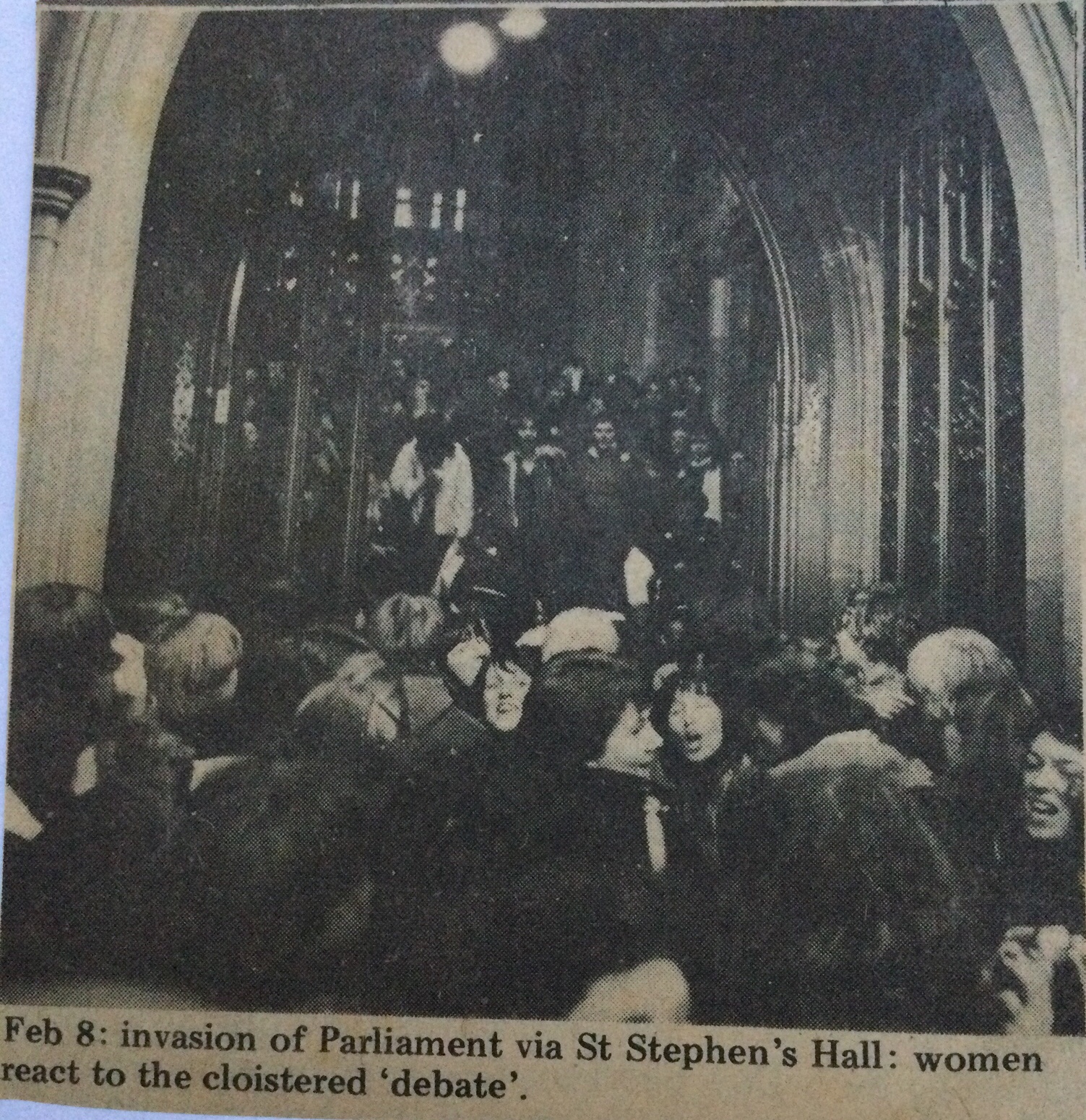
Early in 1980, I bussed down to London, for a further protest against the Corrie Bill at Westminster. After a number of us flowed into St. Stephen’s Chamber, police officers removed us. I was dragged out by the scruff of my neck, struggling for breath, then thrown onto the pavement, winded. From my father’s smile, after he’d bought the next edition of Spare Rib, I discerned his pride in seeing my face amongst the women assembled outside Parliament.

In November that year, I joined a Reclaim the Night March through Leeds city centre. (The first had been in 1977, after ‘the Yorkshire Ripper’ began murdering women.) Not only was he still at large, films depicting violence against women were becoming standard. As well as chanting, we feminist protesters were incensed by these demeanings of women. As the march stopped outside a cinema, where one such film was showing, a policeman seized a marcher, who had been visibly enraged by the screening of such further degradation. Standing three metres behind, I was amazed when local women managed to release her from the officer’s grasp. Thereafter, the demonstration continued without further police intervention.

By early 1981, I was excited to be signed up to the national Lesbian Conference, at Star Cross School in North London. To accommodate the hundreds of lesbians in attendance, the evening’s social took place at a huge hall in Notting Hill. After leaving the event, on my way to stay overnight in another part of town, I got caught up in a melee that had been sparked by others’ encounter with the Met, on the street along which I’d been walking. Glancing down the road, I was surprised to see police reinforcements, which I took to be Special Patrol Group, running up towards us.

A week later, as news from Brixton dominated the news, I wondered whether what I had witnessed had been a trial-run of rapidly deploying back-up.

By the following spring, I was back working at a school in Hamburg, and living in a Frauengemeinschaft, a women’s household (next door to a Frauenbuchladen, a women’s bookshop). In the build-up to May Day, having that March been to the first Hamburgerfrauenwoche (Hamburg Women‘s Week) I was intrigued by posters for a women’s demonstration for women’s rights on Walpurgisnacht (May Eve). When friends and I joined the March, I was startled to spy, spanning the boulevard on which we had gathered, armed lines of police donned in shiny white helmets, alongside ranks of ordinary officers, who stood clad in long leather coats, verdigris sheen catching the weak sunshine. My sister marchers were unsurprised, uttering the German for ‘the authoritarian state’ – der Obrigkeitsstaat. The march proceeded without incident. The next day, I was surprised by the lack of a similar police presence at the trade union led May Day rally, to which I went with my friends from home, each of us carrying a red carnation.

Back in Britain, by the mid-eighties under the second Thatcher administration, women’s campaigns were making key interventions, and appealing to a wide audience. Historic stand-outs were the encampment and circling of the American military base at Greenham Common, and the founding of Women Against Pit Closures. The latter’s aim was to save coal mining communities, in the face of Mrs Thatcher’s determination to close the nation’s pits. Having been struck in the early months of ‘the Great Strike’ by the pluck of the miners’ wives I’d met raising funds in London, and been to the ‘Pits and Perverts’ benefit concert, by the bitter winter of 1984-5 I could see the desperation in the women’s faces as they jangled red buckets outside Camden Town Tube station – knowing their families were hungry and freezing.

On an unseasonably warm and sunny day in late February 1985, I joined the tens of thousands who marched through central London to protest against pit closures. Towards the march’s end, we waited in Whitehall to enter Trafalgar Square for the closing rally. Soon after I’d noticed that a large group of young people had staged a sit-down protest near the entrance to Downing Street, mounted police suddenly charged at the march. Those of us who were ambulant ran, a sister marcher clasping my hand as she and her girlfriend led me away.

Etched on my memory are the stricken faces of an older woman and her grandchild in a Maclaren buggy, fleeing the police charge – her steel-grey and his golden curls bouncing as she mounted the kerb, bumping his pushchair onto the lawns laid near the Ministry of Defence. Afterwards, my friends and I sat in shock, at the disruption of a peaceful, legitimate protest, attended by many first-time marchers. Recently, I’ve wondered what those dispersed that day made of the current Prime Minister’s casting of Mrs Thatcher as eco-warrior.

As the below extract, from a 1938 article, signals: there exists a real tension between popular protest and abuse of police power; this is likely to be stretched tight when the new policing Bill** is enacted.

Without the right of assembly, guarantees of free speech are empty gestures; for if no public forum is available, the right to speak freely is of little value. Nevertheless, right of assembly is subjected to varied restrictions both in England and America. Some have evolved from judicial interpretation of “thecommon law; others are crystallised in statutes.These restrictions have generally been made in the name of public order. They seek to avoid disturbance by punishing conduct which, it is thought, if allowed to continue, might endanger the public piece…

Because such restrictions in the name of public order provide the lawenforcement agencies with broad discretion, they offer convenient legal weapons for curbing the activities of unpopular minorities.”

References

https://livesrunning.wordpress.com/2019/01/16/red-lion-square-and-the-death-of-kevin-gateley/

The Making of the English Working Class Thompson, E.P., Penguin Books,1980

* https://wellcomecollection.org/works/zgvrdk9z

‘Pride’ https://www.imdb.com/title/tt3169706/

** Policing, Crime, Sentencing and Courts Bill: see Justice briefing:

https://justice.org.uk/police-crime-sentencing-and-courts-bill/

Public Order and the Right of Assembly in England and the United States: A Comparative Study, Yale Law Journal,Vol. 47, No. 3 (January 1938)

One Hundred Troubled Years

The deep foreboding of the politics of Northern Ireland that I’ve carried since the Brexit Referendum is now made manifest. Young loyalists’ escalating attacks on Northern Irish police so alarmed President Biden that he’s led the international call for calm.

That the history of the North is so freighted with conflict means it can be used to manipulate impressionable young people and stir them to violence.This year, being the centenary of Irish Partition, it was inevitable that tensions between the nationalist and loyalist communities would be stoked.  In his review of three works that trace the redrawing of the map of Ireland, Colm Tóibín observes: 

“…the border between north and south was created by a dithering British government to satisfy the most intransigent and determined among Ireland’s warring factions. Partition had all the elements of expediency and fudge. All the problems that would result from it – a Catholic minority that felt no allegiance to the new state; the possibility of violence between the minority and the Protestant majority; an unwieldy border impossible to police – were apparent at the very time of its creation.”

Colm Tóibín: Ireland’s bloody line of division, Financial Times, 31.3.21, with the below:

Population Map of the North of Ireland (1923) showing nationalist populations in green and unionist in orange

As armoured police vehicles hinder breaches of a Belfast ‘peace wall’, I recall the deployment in 1969 of British troops, to protect the Catholic minority. 

At that time, Bernadette Devlin was one of my heroes (the other being Angela Davis). Envious when, in 1970, my parents heard Bernadette speak to a huge assembly in New York, I noted later that in the frontispiece to her memoir, my father had inscribed “To Edie, For her ancestors”. 

As I’ve said before, I wasn’t allowed to attend the 1972 York protest following Bloody Sunday. But I soon learned of uncomfortable exchanges with the Police. On a visit to our house, the Old Etonian (who featured in my penultimate post) recounted how, on arresting him, a policeman had grabbed him by the testicles – an excruciatingly painful experience. To hear this shocked me: an avid fan of the avuncular Dixon of Dock Green on TV, I had believed in the harmless ‘Bobby’.

Although I knew from my Queens elementary school, its playground etched with bloody body-map, that armed police were a terrifyingly potent force, on or off duty, such a targeted assault by an unarmed British policeman had, to me, been unthinkable. Being the son of a junior minister in the Heath government, the Old Etonian’s arrest attracted attention: his photo, with cherubic curls and charming smile beamed from the Yorkshire Evening Press.

Years later, I learned of my father’s less physical encounter with a police officer, around the corner from our house.  The protest against the British Army’s killing of 13 unarmed men in Derry on 30 January 1972,‘Bloody Sunday’, led to theYork headquarters of the Army’s Northern Command, on Fishergate. Lines of policemen stood guard.

Former site of Northern Command, Fishergate, York

Leaving the other marchers, my father, a small man with curved spine, approached the sergeant in charge and asked the six-and-a-half-footer (2m) officer:

“Did you know that under the Public Order Act 1936 it’s a serious offence to dress up as a police officer?”

Anxious to learn from my father about Irish politics , and to better understand him, on my weekly visits to his bed-sit a short walk from my new school, I asked about the genesis of the Provisional Irish Republican Army. Sitting on a rug in his basement bed-sit one afternoon that spring, I looked up to him as he told me of the split between the Official IRA and the Provisionals. Hearing that the former had renounced violence I felt aligned with the Officials’ position, and discomfited by the Provisionals’ avowal of the use of force.  None the less, back at home I learned ‘rebel songs’ on The Dubliners cassette, such as The Rising of the Moon, to sing with my father.

At Easter 1974, my parents being reconciled, we visited Dublin. Staying in a lodging house that evoked Joyce’s Dubliners, I was struck by the silence of our hosts’ and other guests’ silence surrounding the Troubles in the North. It was only on attending the commemoration of the Easter Rising outside the General Post Office that I sensed national pride in the struggle for independence. While President de Valera, towering head and shoulders above the crowd, approached the columns of the G.P.O., it was troubling to sight two younger boys dart through and shout “Let’s get the feckin’ red-necks!”

That afternoon, I watched my father, huddled under a damp railway arch, engage in furtive debate with cautious young men, lapels adorned with the Easter Lily badge.  It was then that I sensed despair and frustration with the status quo, and got an inkling of the lengths to which Republicans would go to achieve the goal of independence in Ireland.

The Easter Lily is an emblem of unity between the different traditions within the Irish nation as well as the heroism of those who sacrificed their lives for Irish Freedom. It symbolises unity, equality and prosperity for all Irish people everywhere.

In February 1977, my father took me to a seminar given Robert Skidelsky, J. M. Keynes’s biographer, at Leeds University. At lunch afterwards, Ralph Miliband, my father’s professor, spoke of his visit to Northern Ireland the previous week. It chilled me to hear that, on asking what would happen should British troops withdraw, Miliband had been told there would be a blood-bath.

Two years ago, while visiting my German friend in Hamburg, both of us raw after the random shooting of Lyra McKee amidst rioting in Derry, she suggested that the solution to the issues surfacing from Brexit in relation to the Irish border was to unify Ireland. When I put this to a friend from Dublin, he dismissed that idea vehemently: it would lead to retribution and blood-shed.

In his review of The Dead of the Irish Revolution, Tóibín says it is a companion volume to Lost Lives (edited by David McKitterick & ors). I did not read that book when it appeared two decades ago: the review alone distressed me. The names of two uncles of a friend evoked the bashing down of their door in County Antrim, before they were slain by loyalist paramilitaries during the Ulster Workers’ Strike. That was called in protest at the Sunningdale Agreement, which would have given the Dublin government a say in the running of the North. 

Brexit, and latterly theNorthern Ireland Protocol, was inevitably a slowly ticking time-bomb. The fuse was lit years ago. It beggars belief, then, that after the 2015 General Election MPs at Westminster, seemingly with no clue as to the powder keg on which they sat, voted to enact a Referendum on continued membership of the EU. 

Tearfully, I fear for the survival of the Good Friday Agreement, finalised 23 years ago – the news of its signing, viewed after a visit to the site of the Battle of Culloden in Scotland, feeling as fresh now as wet ink. Half a century after publication, with mid-pandemic civil liberties restricted, Devlin’s words resound: 

“The Price of My Soul refers not to the price which I would be prepared to sell out, but rather to the price we must all pay in life to preserve our own integrity. To gain that which is worth having, it may be necessary to lose everything else.”

To avoid fresh spillage of blood in Ireland, domestic and international stakeholders must act in concert to seek a pragmatic solution, and offer hope to young people in the North. Let us hope that any such intervention isn’t too late.

Five years on

Last week began with a commemoration on BBC Radio 6 Music of the five years since David Bowie’s passing, his own words plugging a programme, simulcast on Radio 4 and Radio 6: “I think the potential of what the Internet is going to do to society, both good and bad, is unimaginable.”

Brixton memorial to David Bowie,five years on
https://www.bbc.co.uk/programmes/m000r4cd

In the light of the suspension of Donald Trump’s Twitter account, following the attack on the Capitol, characterised by Fiona Hill as a ‘self-coup’, I’m sure I wasn’t the only listener to Bowie’s resounding words to have felt his prescience.

And yet, in 1975, Bowie himself provoked outrage, after suggesting an imminent fascist uprising in the UK, and having seemingly developed a fascination with Nazism. Years later, Bowie said that during the recording of Station to Station, his thinking had been aberrant. 

It was in the mid-seventies, when bewildered by Bowie, and concerned that the dominant notion of our rules of ‘fair play’ meant that National Front leaders had to be given airtime, I sought my father’s view. In addition to an encyclopaedic knowledge of twentieth century political doctrine, he protested regularly against neo-Nazis in West Yorkshire. (During a break at the inquest into his death, in 1983, my father’s brother suggested that, in view of that activism, neo-Nazis had killed him.)

Having immersed himself in literature on Nazi doctrine, my father taught courses on Fascism at Leeds and York universities. A former student of his later recounted how my father had goose-stepped his entrance into a York lecture hall – thereby evoking the visceral menace of the SS stamp. 

Aware that Nazism’s core methods were intimidation, violence, the eradication of opposing views, and the genocide of Jews and Roma, I wanted a parental steer as to whether fascists ought to be platformed. My father declared that the danger they posed was so great they must be barred from public platforms. I remember my father’s sardonic grimace, the triumphant gleam of his blue eyes in the glint of his glasses, as he said that as they were like rats – vermin – fascists must be crushed. As a teenager, trying to navigate my way through conflicting ideas, to get such paternal clarity on a topical point of political contention was a tremendous help. I felt physical and intellectual relief: from then on, no longer would I feel bound by conventional wisdom.

Fast forward two decades, when I was tasked to draft UNISON’s response to the new Labour Government’s Human Rights Bill, which was to incorporate into UK law the European Convention on Human Rights (‘the Convention’).

Absorbed in reading about the genesis thereof, the Convention having been conceived after the Holocaust and the total abuse of the rule of law in the Third Reich, I found myself drawing upon my knowledge of Nazism. Trades unionists’ freedoms to speak out and assemble were denied, ‘politicals’ were detained or eliminated.

Against that backdrop, and previous UK governments’-trade union laws, the Human Rights Bill’s potential domestically to challenge such was welcome: freedom of expression (Article 10, (‘A10’)) formed the spring-board from which to exercise the rights to freedom of thought (Article 9) and freedom of association (Article 11, (‘A11’)).

My copy of the Convention, underlining provisions for interference in rights under A10 & A11

In 1997, when Microsoft Word and Outlook email were only just being rolled out at UNISON, and my focus was on the paradigmatic framework the incorporation of European human rights would bring, I had no clue as to how the Internet would rock the foundations of the elected representation on which Western liberal democratic systems were built, post WWII.

Since 6 January, two developments have stood out. First, was the bitter of irony of a Polish bill to forbid administrators of social media websites from banning users.

Secondly, Angela Merkel got flak for asserting that the suspension of Trump’s Twitter account was not lawful. Strictly speaking, in light of the requirement of prescription by law, Frau Merkel is correct. Her interpretation of the illegitimacy of interference with freedom of expression under the Convention presents as “problematic” the revocation of free protections under the U.S. Constitution. In view of her background – the East German Stasi asked her to spy on her father, a pastor, who took part in anti-government protests – one can understand Frau Merkel’s respect for Convention and constitutional rights. 

Yet the big questions are: why governments have allowed ‘Big Tech’ to get away with platforming anti-democratic tendencies, as well as inflammatory misogynistic content, to be spread on the Internet? And whose interests have been served?

In the five years since the Brexit referendum campaign, and Trump’s election, my father’s words on platforming fascists have resounded. Last summer my Quebecoise cousin told me that before the last U.S. general election, a Black friend had seen a noose hanging in a New York park, with a sign attached, “Vote and this will happen to you”.

Those words rang true. In the days after the Brexit Referendum, I worried that organised racists would return to Brixton. As I have written previously, after the UK Supreme Court’s decision in Miller No.2 Remainers’ windows were smashed, under the rubric of ‘traitor’; the Brexit press having denounced senior judges as ‘enemies of the people’. 

By last December, when the trade deal with Europe was under negotiation, to include EU access to fishing in British waters and post-Brexit paperwork, a Leave-voting fisherman was complaining, “… I was brainwashed”.

Covid-19

Aside from effecting Brexit, 2020 saw intrusive powers to curtail movement, the likes of which had not been deployed since WWII. Considering the lawfulness of interference with Convention rights, A10 and A11, and the prohibition on gatherings, the Joint Committee on Human Rights pondered whether the UK’s lockdown rules were ‘prescribed by law’. It was noted, for example, that the policing of Black Lives Matters protests, where social distancing had been observed, had been called into question.

Brixton poster – note request to bring a mask

Perhaps it’s not surprising that there’s been a backlash against governments. Most disturbing of all, though, is the venting by anti-progressive forces, fuelled by intolerance of the rights of others, and using social media’s proverbial ‘echo chambers’, to mobilise protests on the streets, to incite violence and intimidation; the most recent example in London being Covid deniers’ intimidation of NHS workers outside St Thomas’s Hospital.

Latterly, German security services have become alive to their deniers of science, Querdenken, including ‘anti-vaxxers’ and conspiracy theorists who, in organising intimidatory anti-Shutdown protests, are seen to pose a potential threat to the constitution – so severe as to be on a par with that of the Red Army Faction in the Seventies. In response to the attack on the Capitol, security at the Reichstag has been heightened. 

Hydra-like manifestations of ignorance, when organised to attack ethnic minorities lesbians and gays and women are terrifying. The critical challenge for progressive thinkers and activists is to devise a strategy to combat prevailing misinformation, and populists garnering a mass base via denialism and contempt of experts. 

First, the fight against these incursions into the public domain via the Internet will require clarity as to what we face. Shocked by the invasion of the Capitol (and previously of the Reichstag) I’ve been tempted to lump together right-wing populists (Rechtspopulisten) as ‘fascists’. Reminding myself that Fascism and Nazism are political doctrines of historical specificity, however, I’ve turned to David Renton’s analysis of far-right traits and trends.

In The New Authoritarians Renton asserted, “we are in a post fascist moment”. He noted:

However, as the far right has grown, in particular since 2016, we have started to see initial signs of parts of the politics of the 1930s returning… From the perspective of those who identify with the far right, fascism is a ‘tight’ ideology, which provides a series of positions which justify the adoption of violence and offer its supporters not just the excitement of military struggle and race war but in the final stages a new society and a new fascist mandate. Nothing developed by the far right in the past decade, in the US or in Europe, offers the same coherence.”

Trump’s mobilisation showed the deadly combination of the rights to free speech and to bear arms. Given the far-reaching networks of Neo-Nazis, such as Atom-Waffen SS in and beyond the U.S. the forces unleashed by the Internet, and the risk of fascism’s revival, my father’s words echo in my ears.

Secondly, it’s imperative that we stand together. Not only was my father crystal-clear on platforming: had the Left united, Hitler could have been stopped.

Already, there are hopeful signs in the U.S. In Georgia, Black and Jewish Americans harnessed years of campaigning in a coalition to mobilise voters for Democrat candidates, Ossoff and Warnock, in the run-off Senate elections.

Across ‘the Pond’, where concerns already exist as to some EU member states’ adherence to the rule of law, we must now call on our elected representatives to address the management of A10. A reappraisal of the effectiveness of democratic governments’ application to Big Tech of the rules governing interference with freedom of expression is long overdue. Before we see further violence on our streets,the State must draw linkages between conspiracy theorists, disinformation and hate-crimes – and punish law-breakers for breaches of criminal law.

References

  1. https://www.newstatesman.com/david-bowie-bellwether-anniversary-death-five-years-fringe-ideas-mainstream
  2. https://www.politico.com/news/magazine/2021/01/11/capitol-riot-self-coup-trump-fiona-hill-457549
  3. https://www.spiegel.de/netzwelt/web/angela-merkel-findet-sperrung-von-donald-trumps-twitter-konto-problematisch-a-c216cbcb-c32f-4c12-b965-cf683241acf0
  4. On being silenced, my 6th blogpost (6 October 2019)
  5. https://www.ft.com/content/b47b2786-92be-4ad4-8ca8-e23a3a60bbc4
  6. https://www.ft.com/content/4f224474-4604-431a-9752-0e5cf00c67bd
  7. House of Commons House of Lords Joint Committee on Human Rights, The Government’s response to COVID-19: human rights implications, Seventh Report of Session 2019-21
  8. The New Authoritarians, Renton,D. Pluto Press, 2019 http://www.plutobooks.com/9780745338156/the-new-authoritarians
  9. https://www.newstatesman.com/world/2021/01/american-civil-war
  10. https://www.newstatesman.com/world/north-america/2021/01/mob-may-have-been-cleared-us-capitol-violence-likely-continue
  11. https://www.spiegel.de/politik/deutschland/holocaust-gedenken-charlotte-knobloch-warnt-vor-antisemitismus-udn-schoa-verharmlosung-a-95b93b19-9729-4bf9-8691-24e5b0fce85c

Two Rivers, Two Women

As this year began, I found myself wondering, after the General Election, what had become of class consciousness. Although my social class was determined by father’s membership of the academy, Edie’s mantra was “I’m from the working class.” ( And arguably, after kicking out my father she resumed that class position. ) 

On the far left, Edie aged about 14, holding her younger sister, Sheila, at a street party – probably during the Festival of Britain, 1951 (to celebrate the end of austerity, & British science, industry and arts)

Family lore of my Liverpool-Irish family was that Edie’s maternal grandmother had been such a prominent activist during Liverpudlian unrest before WWI – when Churchill’s warships were poised in the Mersey – that her comrades thronged her funeral procession, to pay her tribute. 

Before we left Liverpool in 1963, Edie was an anti-nuclear activist. And as I indicated ( in my post, On the Perils of Looking West ) in Queens, New York, Edie found a more congenial mix of class and race in the American feminist milieu than that she had known in England.

On our return to York, as the activist Seventies got into gear, Edie joined a community theatre group of former York students – working with kids on the council estates on the city perimeter, and in adventure playgrounds. ( So great was the appeal to Edie of this new-found freedom, that she was later persuaded to see the Grateful Dead at the Bickershaw festival – I recall her return, in mud-splattered cords .)

Meanwhile, like my father, Edie succumbed to the charms of the Old Etonian – in this case one of his former students, and an IS* acolyte. After Christmas, Edie invited him, the son of a junior minister in the Heath government, to stay with her parents in Liverpool. On the brink of separation, my parents stayed elsewhere, while I stayed with my grandparents in their two-up, two-down house. 

It was midwinter, the gas-fire warming the living-room, when our guest, towering over my Grandad, produced his (now rather tatty) Eton top hat. I couldn’t see the rationale for this, but it struck me as belittling; my face reddened. After the Old Etonian left the room, my Grandad turned to me, visibly choked with anger and hurt, and asked:” What’s she [Edie] doing bringing a toff here?” – a question I, just turned 12, didn’t know how to answer. 

A pristine top hat

That was not the first time in my childhood that I felt acute embarrassment in my grandparents’ house. In the late Sixties, my Nana, whilst telling me of her first job, as a waitress in the city centre, said she had been uncomfortable when she had to serve a “Darkie” in the restaurant. I was mortified that she should express such a sentiment, and use such a word. ( Shortly thereafter, feeling that ‘Coloured’ also wasn’t right, I asked my father what people of colour preferred to be called. His clear answer: ‘Black’, which was also a political statement, has since echoed in my ears. ) 

A couple of years after my father’s death, Edie and I spent a weekend in Liverpool. At the Pier Head (at which, my father had told me, mass demonstrations had assembled) Edie, noting the water-side monument to workers’ struggle and asked me: “Where’s the memorial to the slaves?” Again, I had no answer.

That same trip, Edie wanted to return to the remains of the street in which she had grown up. ( My Grandad bought the house which I knew with a trade -union-won settlement from an industrial injury. ) All we found was a new road. Edie’s loss was palpable: the absence of any vestige of her former home, the dispersal of the vital community in which she was raised. That evening, on visiting her aunt in hospital, we met Edie’s cousins, Pearlie and Bernie. Along with most of the residents of inner-city Liverpool, on ‘slum clearance’, they had been re-located to new estates. Pearlie now had a flat in the Netherley mega-estate, her adult sons, both unemployed, lived with. We spoke of their hopelessness at finding any work. 

A Covent Garden doorway

Latterly, that time of mass unemployment has founded a foreboding. In the week before lockdown, I went to Covent Garden. After wandering deserted streets, I popped in to a Swedish bakery. I sensed that, given the imminent economic impact of the pandemic on consumer demand, the shop would close and this would be my last visit.

A lane, Covent Garden

In my last post, I wrote of the death of an aunt, an in-law who caught Covid-19 from a patient in the opposite hospital bed. In the months since, I’ve been trying to fathom how she, an open-minded Londoner – like my Grandad from the banks of the Thames – came to be an ardent Brexiter. Until I returned to her empty house in Bexleyheath I had assumed her stance was due to ignorance of the complexity of our links to the EU. 

Joan in her late teens, during WWII – following her return to London from Devon, where she was evacuated on 1 September 1939

It was only when I searched Joan’s study for paper to wrap her modern ceramics that I found evidence. Stapled together were newspaper cuttings: articles ranging from the challenges to the prorogation of Parliament to the expected Tory victory in the General Election. This, Dominic Lawson anticipated, would be down to the Labour Party’s late conversion to a People’s Vote: rather than sticking with Corbyn’s avowedly anti-EU stance – on the basis of sovereignty – the Labour Party had lost its way.

Here was proof that we’d been inhabiting parallel worlds. Whilst I was reading the judgment in Cherry, Joan was wondering whether the Queen would be called to give evidence when the appeal went to the Supreme Court. As I flew in from Hamburg, Joan was bemoaning her incapacity – only that prevented her from marching for Brexit. After the coverage of the court hearing in Miller No.2 that I had seen in Germany, my feelings were much more mixed ( see my post, On Being Silenced ).  Useful in sloganeering, by the General Election, ‘the People’ had morphed from the “Will of the People” to the ‘People’s Government’ –  though it’s too early to tell whether a new strain of popular Tory politics, or Volkskonservatismus, had indeed been cultivated.

In addition to the cuttings, a pile of books showed that Joan and her husband had pondered identity and belonging. Intrigued, I took ‘The Likes of Us’.  Although, elements of the book resonated – wholesale destruction of working-class communities, erection of massive estates, and ‘flight’ to cities’ fringes, such as Bexleyheath – I was appalled. 

Here’s why. First, echoing a family friend from the Liverpool Left, the author’s citation of texts that enslaved people in the Caribbean were better fed than English workers offended me: however ill-fed my forebears were, they retained certain civil rights – the most banal being to marry and to found a home and family. Second, the author’s seemingly uncritical endorsement of the anti-immigrant trope of the too large family attributed to migrants from Ireland and the Indian Sub-continent struck me as encoded racism, akin to the New Right’s cultural xenophobia propounded since the mid-Eighties in England and France. Third, the accrual to the racist perpetrator of psychological and physical power wasn’t explored, in my view.

Fourth, the book’s inwardness of focus on Southwark troubled me. From my days at UNISON, when, following her uncovering of dodgy deals, I was able to support a member in her claim against Southwark council, and from my knowledge of Liverpool, I knew that insular cultures can engender tolerance of law-breaking. 

Finally, the odd reference to ‘toffs’ aside, I was amazed at the apparent lack of cognisance of class consciousness. Finishing the book, I concluded that Joan, unlike my family with their fighting spirit, must have felt powerless to effect change through collective action. Perhaps, feeling let down by politicians, drawn by the appeal of the ‘free-born Englishman’, she focused on national identity – and, ultimately, fell for the charm of an Old Etonian. 

Tate Modern, Bankside – the Peabody Buildings, where Joan spent her pre-evacuation childhood, set back a few blocks from Bankside, aren’t visible

References
*IS, International Socialists (of which my father was a founder member) predecessor to the Socialist Workers Party.

https://www.brh.org.uk/site/events/liverpool-1911-a-city-on-the-edge/

https://www.amazon.co.uk/Send-Gunboats-Mersey-Brian-Benjamin/dp/1093130997

The Likes of Us, Collins, Michael, Granta, 2004

Food and the legacy of slavery, The Food Programme, Radio 4 https://www.bbc.co.uk/programmes/m000lstp

Freedom: the Overthrow of the Slave Empires, Walvin, James, Hachette, 2019 https://www.hachette.co.uk/titles/james-walvin/freedom/9781472141446/

Cherry v Lord Advocate of Scotland; Miller v. the Prime Minister

Boris Johnson https://www.rowohlt.de/paperback/jan-ross-boris-johnson.htmlRoss, Jan

A painful analysis

Since losing a younger friend to the virus I’ve been preoccupied by lives being put at risk. The net is so wide that anyone could have been caught commuting to, or at work, at a mass gathering, whether a music festival, or a football match, or shopping.

Waiting for Iceland to open, 19 March 2020

Pondering other insidious and invidious contaminants, a parallel struck me: radio-active fall-out from a nuclear accident. Remembering reports of a radio-active cloud wending its way to these isles from Chernobyl, in May 1986, I recalled the twitchiness of friends in the Midlands, whereas, in London, Steven and Nina Lukes told me they’d stopped buying dairy products.

In her most recent blogpost, Ursula Huws identifies various workers at risk; she doubts that they’ll be protected against contagion. [1] Unorganised workers may not be aware of health and safety protection. For workers who are “employees”, there’s the right not to be punished for taking action in response to “circumstances of danger which the employee reasonably believed to be serious and imminent” [2] Until recently, this was seen as guarding against visibly unsafe systems of work, such as building sites. This certainly changed when the British Medical Association sounded the alarm, as doctors and nurses began to die.

Only now, have I realised that my own fear of contamination stems from the threat, omnipresent during my childhood, of nuclear war. As I mentioned in my 7th blogpost, my parents told me early on that we all faced an apocalyptic end. In my early teens, after I’d consumed Orwell, my father told me that Orwell had believed 1984 would come to pass. Then on my return from austere Münster, where I’d spent three weeks reading Doris Lessing’s The Four-Gated City, he told me that in the event of WWIII the government would convene in Regional Seats of Government (RSGs).

On my last visit to Hamburg, after Abendbrot (tea of rolls and cheese) my physicist host put the small personal Geiger Counter and app he’d invented on the kitchen table. He showed me how German physicists and school-students will be able to measure radio-activity in labs. Geiger counters are of course deployed to measure the exposure in radio-active zones. Thus, the risk of further contamination can be contained.  

Like my Hamburg host, another German scientist was a forerunner.  When it came to the virus, Olfert Landt put Germany at the forefront of diagnostic testing. In early January, he “recognised the similarity to SARS and realised a test kit would be needed… As well as having an effective test in mass production, Germany signed up politically to mass testing from the beginning…”[5]

As have many political leaders, Angela Merkel has got flak for holding back on tough measures, in order to protect their national economy. Germany, however, is fortunate in having a scientist as Chancellor. Thanks to political will, technical expertise and robust health systems, it seems that the answer to the question posed on the Coronavirus special edition of Der Spiegel, “Are we prepared?” the answer is a tentative “Yes”: in the first few days of April, the number of new cases decreased.[6] Against a backdrop of critique that forbidding visits to homes is unconstitutional, there’s even hope that after Easter some lock-down restrictions might be relaxed.

The Department Store – a usually buzzing Brixton cafe-bar

As Der Spiegel emphasised, however, the virus will be fought by logic and mathematics; [7] though the number of infected people is misleading – more revealing is the number of deaths. [8] So, while raw figures indicate the virus has infected more German than British people, the below statistics confirm that the death rate in Germany is much lower than in other Western European countries.

CountryConfirmed casesDeathsMortality Rate %
Taiwan        373          5 1.34
Germany100,186  1,590 1.58
Spain135,03213,055 9.66
United Kingdom  48,451  4,93410.18
Italy128,94815,88712.32
South Korea10,284 186  1.81
U.S.A 337,971Recorded by stateNo national figure
Data taken from Centre for Systems Science and Engineering John Hopkins University
on 6 April 2020(9)

Had there been more widespread testing in England, the mortality rate would be lower. In his Morning Call, Stephen Bush signalled last week that the UK lags far behind other developed nations in testing for the virus. [10]  The recent announcement of increased testing would, incidentally, reduce the statistical death rate. 

To focus on the stats is to displace the pain. Since I began drafting this blog-post, I have lost a “loved one”. An elderly aunt, one of six sisters, she who, had to share a bed with them in a Bankside Peabody flat, was quarantined in a fever hospital, was later evacuated the day before war was declared – only to be admitted to hospital with a broken wrist 6 weeks ago. Laughing and chatting to the end, the virus struck her down. Somehow, thrashing in the waves of grief, I wonder how on earth, in the absence of testing and contact tracing, she got the virus in hospital – and who else had caught it before she was diagnosed.

Lessons will be learned, most likely from Germany, South Korea, and Taiwan, which is being hailed as an exemplar. With a population of 23m, and having a store of knowledge from SARS, its government, led by President Tsai Ing-Wen, and drawing on the expertise of a prominent epidemiologist, put in place rigorous measures – as Taiwanese people were cautioned against the dangers of hoarding. Her list of official engagements included inspection of the Army Chemical Corps’ epidemic prevention preparedness, at the end of February.

Empty rice and pasta shelves, Waitrose Barbican, London

Aside from difference in approach in handling between a political culture[11]of seeking certainty and a scientific one grounded in uncertainty, another cultural rift is surfacing – between rights and responsibilities.

In view of statistics on recent car journeys in the UK, I wonder how mandatory masks might be enforced in the UK[12]. Perhaps, in addition to the Englishman’s home being his castle, there’s a presumption of the right of every car-owning ‘free-born’ Englishman or woman to drive at will – free from interference by state agents. From casual observation of the streets and parks of London, new rules on maintaining social distance are being flouted. Would wearing a face-mask be seen as a similar encroachment on liberty? Contrast push-back on isolation measures in the West with South East Asia where, post-SARS, wearing a face-mask is seen as fulfilling one’s social duty [13]  

In a further sub-set of the competing rights, inter-generational difference is surfacing. Although the EU has in the past decade highlighted potential tensions, it’s taken this pandemic to bring to the fore deeply conflicting, fundamental, interests. Reports of young people in particular chafing at lock-down restrictions might be an expression of resentment towards ‘Boomers’. [14] Now that the virus is killing children, folk who believe their fitness will protect them might at last take note. 

When I wanted to work in Hamburg, I resented the intrusiveness of testing bodily samples, and the use of personal data: before I could live and work in Hamburg, I had to give blood and stool samples. Yet I understood the purpose of such, and of the over-arching public health bureaucracy, was to reduce communicable diseases.

In the current climate, it seems that Germans are abandoning their support for Alternative für Deutschland, and for the Social Democratic Party and the Greens (the latter of which had surged). Perhaps they are seeking the safety of ‘a safe pair of hands’ such as Frau Merkel’s [15]. To the south-east of Germany, Viktor Orban’s concentration of power in his hands indicates how the ‘far right’ is making use of this crisis [16 ]. This pandemic is showing how the right to access the very means to sustain life might be contested.

Last bag of carrots, 10 pence each, Brixton Market

In England, as WWII and the Dunkirk Spirit were invoked, the only parallel I drew was of fear – induced by the threat of invasion: hoarding; crowds outside shops; and the impulse to the flee “the Big Germ”.  Only those few with the means to bulk buy, or to sit it out in a ‘funk hole’ are sitting tight atop their piles.

Meanwhile, orderly queueing has returned to the streets of Brixton. Let’s hope that in a sign of a yet more divided nation, good prevails over bad, and this crisis engenders other more congenial and co-operative ways of being.  


[1] The dialectics of self-isolation, Ursula Huws https://ursulahuws.wordpress.com

[2]See: section 1(d) 44 Employment Rights Act 1996, which gives an “employee” this statutory right.

[3]Der Spiegel “Heimliche Pandemie” “Furtive Pandemic” 15.02.20  

[4]  Ebola co-discoverer Peter Piot on how to respond to the coronavirus, FT 28.02.20

[5] https://www.theguardian.com/world/2020/apr/02/coronavirus-testing-how-some-countries-germany-south-korea-got-ahead-of-the-rest?CMP=share_btn_link Peter Beaumont,The Guardian, who points out that the UK passed over the test; lessons are being learned from German mass testing; see https://www.ft.com/content/49f3b95a-167e-4784-b099-614486f0ff53;
https://www.ft.com/content/cc1f650a-91c0-4e1f-b990-ee8ceb5339ea

[6] Der Spiegel, Corona Spezial,14.03.20 

[7] Ibid, Editorial – Die Logik des Virus

[8]https://www.spiegel.de/wissenschaft/medizin/corona-pandemie-was-uns-die-zahl-der-toten-verraet-a-ca5dc909-716c-44ac-806f-530a109161212/4/20

[9]https://gisanddata.maps.arcgis.com/apps/opsdashboard/index.html#/bda7594740fd40299423467b48e9ecf6

These rates are in flux: as at 1 April, on my calculations, Germany had a 3% mortality rate, whereas the UK’s was 8.5%.

[10] https://time.com/5805629/coronavirus-taiwan/ “ …Of course it is not out of the woods yet, but so far it has led the way, deploying a combination of big data, transparency and central command.

[11] See Stephen Bush Morning Call, New Statesman

[12] See last FT graph showing comparison in car journeys https://www.ft.com/content/84d96dee-45f9-4870-88b5-d39f929c06be

[13] https://www.ft.com/content/d7057a2e-739d-11ea-95fe-fcd274e920ca Gillian Tett, FT

[14] See e.g. comparison of rates in Lombardy and Veneto
FT https://www.ft.com/content/9c75d47f-49ee-4613-add1-a692b97d95d3

[15] In her grasp of evidence and marshalling of argument, Angela Merkel impressed me when I saw Anne Will,  interview her on German television –  after the Kanzlerin took a stand and adopted a humane approach to the refugee crisis of August 2015.

[16]https://www.theguardian.com/commentisfree/2020/apr/07/how-the-right-is-responding-to-the-coronavirus-denial-realism-or-dangerous-contrarianism Jason Wilson

Après le déluge

Waking in darkness a month ago, I crept out of the house. Boycotting the BBC, I wanted to survey the array of banners at Brixton Underground’s newsagents. I wasn’t surprised: we had been here before. 

In 1984, subdued by Labour’s defeat, I spoke with Raphael Samuel about the implications of Margaret Thatcher’s second victory, after the patriotic ardour for Falklands War (which, living in Hamburg, I had missed). Raphael told me that nationalism and identity under discussion in History Workshop.(1)

The following year, I began to question my loyalty to Liverpool. Although I took pride in Liverpool’s oral and oppositional culture, it was hurtful to hear an in-law deride Toxteth – where the Black people lived. In 1989 James Walvin, slave historian, told me it was odd that the Black community had remained in the area where it had first settled near the docks over 400 years ago. My visits ‘home’ became more marked by caution. When I visited a picket on Dock Road, I was shocked to hear a docker blame immigration for the Port of Liverpool’s decline. 

But was only in 2007 that things began to fall into place. Caryl Phillips had signposted (2) heads of Africans represented on the exterior of Liverpool Town Hall (3), and the city’s support of the American Confederacy – enabling them to build a navy to engage with Union forces. That year, I happened upon a decaying Georgian terrace, with plaques of Southern states.  One such was Alabama House, which had served as the unofficial Confederate embassy – a massive Confederate flag still (in that bicentennial year of the Abolition of the Slave Trade Act) festooning its rear courtyard.

A few years ago, a friend from ‘the Continent’, who had moved to Liverpool, told me that in 18 months she had been at the receiving end of more anti-European hostility that she’d ever encountered during 18 years in London. All this in a city that, having benefited from ‘Objective One’ EU funding, and historically hostile to ‘The Sun’ Press, has been pro-Europe in its voting pattern.

This in a city that, having benefited from ‘Objective One’ EU funding, and historically hostile to ‘The Sun’ Press, has been pro-Europe in its voting pattern.

Flooded fields, Devon, December 2019

How to make sense of this?

Last month, I happened upon a historian whose discourse analysis has helped me untangle the net that’s been cast over recent years (4). Robert Saunders pinpoints the end of the Cold War as the catalyst for the birth of modern Conservative Euroscepticism. With no threat from the Soviet Union, and Washington bound to serve as guarantor of worldwide free trade, Eurosceptics latched on to uncoupling from Europe to revive British fortunes: On our own we’ll be strong again.

Saunders teases out 5 strands:

  • Within the narrative of warfare, the dominant myth of the ‘Dunkirk Spirit’ is unusual in its depiction of standing up to German might: it was a retreat. (The return to English shores of troops by all of ‘the little ships’ is a misconception.British Navy ships picked up most most men from the breakwater; from the beaches smaller civilian vessels ferried troops to the Navy’s ships that were waiting in deeper waters; a number of such vessels took troops all the way to England.)

  • Rather than Brexiters fixating on ‘the good old days of Empire’, it is Remainers who have ascribed that notion to them. Instead, Brexitism is silent on the British Empire. Much more exciting is the Elizabethan Age. 
  • Imagery has shifted from the imperial lion to the British Bulldog and onto ‘the little man’. Saunders suggests that in voting for Brexit voters could feel empowered, glorifying in the island’s smallness.
  • Brexiters’ ideal scenario would be to excise from our island history our messy imperial past. Omitted from the national narrative is the contribution of Commonwealth servicemen and women to British military success in two World Wars. 
Memorial, Windrush Square, Brixton, London
  • Only recently have right-wing Eurosceptics rallied against an ‘evil’ European empire. In the Sixties and Seventies, it was leading Labour Party politicians on the Left, such as Tony Benn, who campaigned against the loss of national sovereignty (6). (And in my father’s case, voted against a blocking of international workers’ solidarity.) 

At the other end of the europhobe spectrum, Enoch Powell is increasingly cited as the driving force behind Euroscepticism. Saunders cites his historical revisionism: “…the greatest task of the statesman is to offer his people good myths and to save them from harmful myths…” (7)

In tandem with Saunders, Ferdinand Mount (8) locates Powell within debates on Europe, starting with Powell’s speech in Birmingham in 1968 (on 20 April, Hitler’s birthday, incidentally). His arguments were: “a calculated combination of the commonplace, the untrue and the toxic.” Then, in 1974, Powell urged the electorate to vote Labour – to get a referendum.  

“It was Powell…who fully articulated the four separate obsessions that melded to inspire the Brexit movement: loathing of mass immigration, revulsion against the EU, dislike of devolution in any part of the UK, and disdain for human rights”.

As an ‘Anonymous Westminster Insider’ observed recently: 

“It’s only when considering Brexit as an assertion of identity that its true nature, and the gravity of the threat it poses, becomes clear. Framing the debate solely around ideas of financial value not only misses the point, but dangerously underplays the magnitude of the deep psychological and cultural divisions that have been exposed.”(9)

Moreover, in the rewriting of history, Brexitism overlooks the past contribution of migrants to these shores. 

English Channel

It looked inevitable that, absent a united Opposition with a compelling counter-narrative, Brexitist argument would, in its seductive simplicity, win any forthcoming General Election. From where I was sitting, it seemed that history was about to repeat itself: catchy slogans, repeated in mantra-fashion, would resonate deeply with those for whom “Europe” was a proxy for other ills (10).

Rewriting history morphed into reliving it when I visited Hamburg last September. Watching live reactions to the Supreme Court’s ruling that the prorogation of Parliament was unlawful, my host – although agog at the BBC interviewer’s preferencing of male commentators – turned up the volume. While she watched the entire proceedings, a sick headache forced me to abort my TV goggling – “This is a dead Parliament” resounding throughout the apartment. 

Such clear messaging would appeal to the ‘floating voters’ who had voted ‘Leave’. Losses in ‘traditional Labour’ towns in England and Wales would be significant, Labour having lost Scotland in 2015. 

Revisionism’s reach is wide, however – stretching to streaming. In the third series of The Crown, the portrayal of the former King Edward VIII, the Duke of Windsor, is sympathetic. This is at odds with earlier episodes, which showed archival footage of the ducal couple on their “goodwill” tour of Germany, lapping up Nazism, sidling up to Hitler. The episode, Vergangenheit” focused on the ‘Marburg files.’

None of this was a surprise to me: when I was 10 my father had given me a heads-up. He said that had Edward VIII remained King things could have turned out differently– with his Nazi sympathies, he might have capitulated to Hitler. According to a review of the second series of The Crown, the Duke blamed British involvement on “Roosevelt and the Jews”. (11)

Edward VIII’s motto, German for ”I serve” and Prince of Wales’s feathers, Brixton pub

In my teens, my father told me that in researching his course on Fascism he had nightmares about the Gestapo’s hunting of Jews. I like to think that my father would have joined me in walking out of my maternal aunt’s eightieth birthday party in Liverpool – in response to the ‘entertainer’s’ anti-Semitic ‘joke’. Last year, one of my in-laws told me he was thrilled that at last the Labour Party had a strongly Marxist manifesto. I had to remind myself that this man had laughed at that ‘joke’. 

From Northern Ireland Will Never Be The Same Again, Centre on Constitutional Change

Against the backdrop of ongoing demands for Irish and Scottish self-determination, debate as to what it means to be British/English/Liverpudlian is apposite. But the Left must neither hark back to Orwell (whose oft-cited essay I now read as an expression of ‘Blitz spirit’ (12)); nor must it ignore past abuses of patriotism, in which English nationalism – such as Powell’s, equated to national superiority over other peoples. Last week, the following in the Guardian’s letters page summed up my concern: “Patriotism cannot be progressive if it masks hostility and prejudice.” (13)

Since the referendum, regional and national allegiances have come to the fore.Cut loose from ties forged in the Industrial Age through trades unions – to ‘agitate, organise, educate’ – a sense of kinship with the Labour Movement has atrophied.  In these febrile post-industrial times, things have come unstuck. Adrift without either a cohering infrastructure, or social ‘glue’ to bring them together, folk feel free to express hostile attitudes.

Shortly before his death, in 1983, my father had said that the way forward lay neither in the organised Left nor in the Labour Movement, but in grass-roots oppositional campaigns and feminist struggles. To build counter-hegemonic practice, one must chip away at ready-made tropes and simple monoliths. In her trenchant analysis, Katrina Forrester signals the need for a recharting of political waters. (14)

Inundated Devon fields, December 2019


(1) See: Grand Narratives: http://www.historyworkshop.org.uk/history-workshop-journal-virtual-special-issue-raphael-samuel/

(2) http://www.carylphillips.com/the-atlantic-sound.html

(3) Described by English Heritage: “Between capitals of pilasters are panels carved in high relief, with exotic emblems of Liverpool’s mercantile trade, such as African and Indian heads, an elephant, a crocodile and a camel.”

(4) https://magazin.spiegel.de/SP/2019/51/167510388/index.html?utm_source=spon&utm_campaign=centerpage

(5)  https://www.theguardian.com/books/2018/mar/29/yes-to-europe-robert-saunders-review-tony-benn-vote-leave?CMP=share_btn_link

(6)https://www.theguardian.com/books/2018/mar/29/yes-to-europe-robert-saunders-review-tony-benn-vote-leave?CMP=share_btn_link

(7)https://www.newstatesman.com/politics/uk/2019/10/myths-small-island-dangers-buccaneering-view-british-history

(8) https://www.lrb.co.uk/contributors/ferdinand-mount

(9)http://loupemag.com/issue-10-out-now/

(10) See: In My Father’s Footsteps, Mike Carter, his FT article, and https://www.theguardian.com/books/2019/jan/28/all-together-now-one-mans-walk-search-of-father-lost-england-mike-carter-review?CMP=share_btn_link; and Aditya Chakraborty’s https://www.theguardian.com/commentisfree/2019/dec/14/labour-meltdown-decades-govern-votes?CMP=share_btn_link

(11) https://observer.com/2017/01/the-crown-netflix-secret-history-duke-of-windsor-nazis/

(12) See:The Lion and the Unicorn: Socialism and the English Geniushttps://www.orwellfoundation.com/the-orwell-foundation/orwell/essays-and-other-works/the-lion-and-the-unicorn-socialism-and-the-english-genius/  (On my thirteenth birthday my father gave me his set of Orwell’s Collected Essays, Journalism & Letters. )

(13) Letter to the Guardian, 2.2.20

(14) https://www.theguardian.com/books/2019/nov/18/crisis-in-liberalism-katrina-forrester?CMP=share_btn_link


Design a site like this with WordPress.com
Get started